


Running a business means wearing more hats than most people ever see. You may be the CEO, head of human resources, chief problem-solver, motivator, and sometimes even the unofficial therapist. But when your company sponsors a retirement plan, another responsibility enters the picture: acting as a fiduciary under ERISA.
On FiduciWho, I spoke with Eric Dyson, a Naval Academy graduate, former nuclear-trained submarine officer, and ERISA fiduciary consultant with more than 30 years of experience. His message was direct: a 401(k) is not merely an employee benefit. It carries legal, ethical, and leadership responsibilities.
That distinction matters because plan sponsors make decisions that can affect employees for decades. The investment menu, fees, service providers, disclosures, and documentation process all influence whether the plan helps people prepare for retirement or creates unnecessary confusion and risk.
Good planning is not about adding the most bells and whistles. It is about building a clear, durable foundation that employees can understand and trust.
Quick Answers
What are 401(k) fiduciary duties? They are responsibilities imposed on people who exercise authority or control over an ERISA retirement plan, including acting prudently, acting loyally, diversifying investments, and following the plan document.
Why do 401(k) fees matter? Plan sponsors need to understand what the plan and its participants are paying, what services those fees cover, how the fees are collected, and whether the costs are reasonable.
Should a 401(k) offer many investment choices? More choices are not always better. A focused, diversified lineup may be easier for participants to understand and use than an overwhelming menu of overlapping funds.
Why must fiduciary decisions be documented? Documentation helps demonstrate that plan decisions were made through a thoughtful process rather than personal preference, convenience, or guesswork.
Does every small business need a 401(k)? Not necessarily. A SIMPLE IRA or another arrangement may be worth evaluating when a business needs a less complex starting point. The appropriate structure depends on the company’s goals and circumstances.
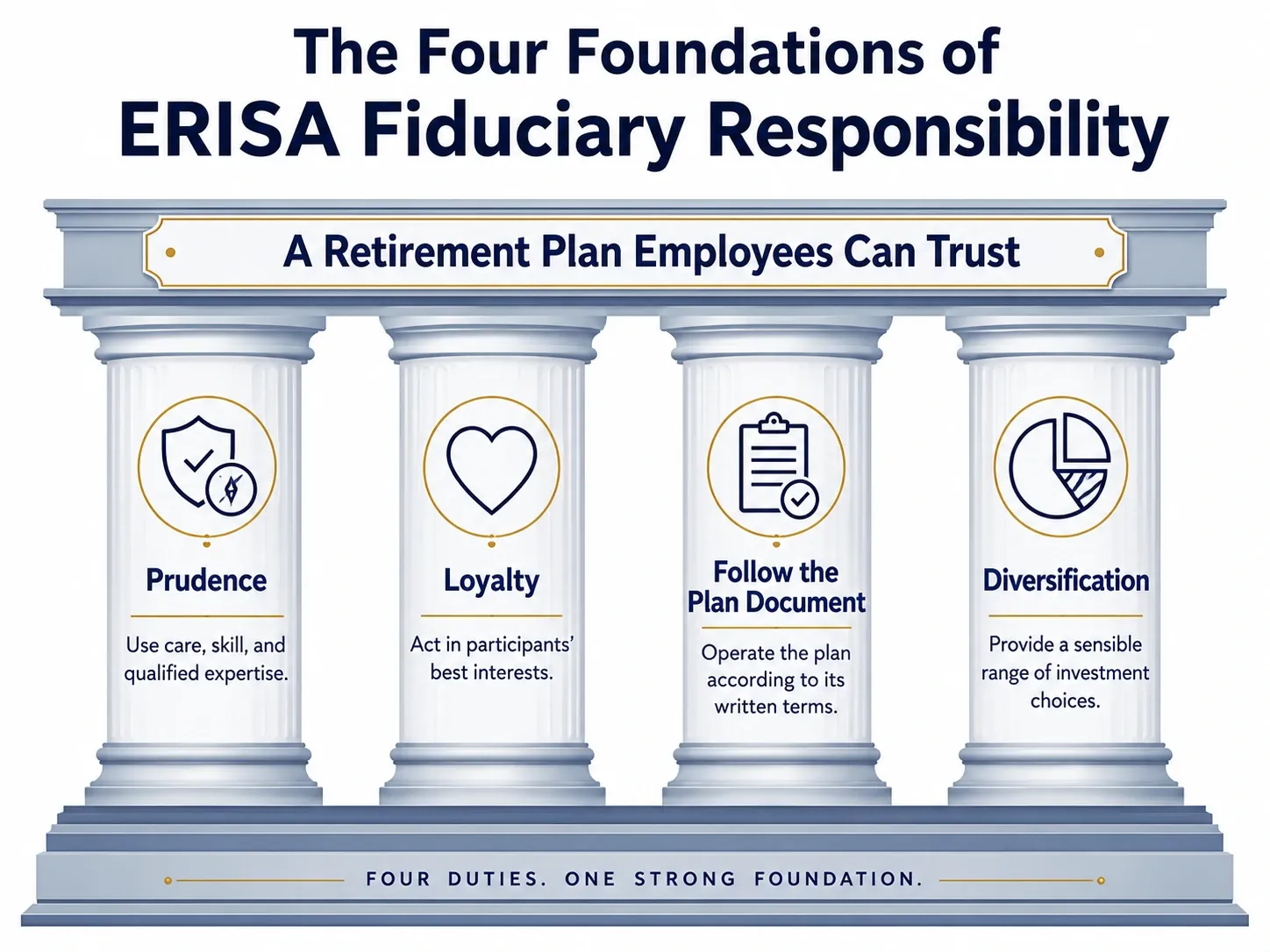
The Four Core 401(k) Fiduciary Duties Under ERISA
Eric described four foundational duties that every plan sponsor should understand. These responsibilities are not one-time tasks completed when the plan is opened. They shape how the plan is selected, monitored, documented, and operated over time.
Duty of Prudence
The duty of prudence requires fiduciaries to approach decisions with care, skill, and diligence. A business owner does not need to personally become an investment, legal, or retirement-plan expert. But when specialized knowledge is required, prudence may mean hiring qualified professionals and monitoring their work.
The important point is that delegating a task does not eliminate the need for oversight. Plan sponsors should understand who is doing what, what services are being provided, and how those providers are evaluated.
Duty of Loyalty
The duty of loyalty requires fiduciaries to act exclusively in the interests of plan participants and beneficiaries. Plan decisions should not be driven by a business owner’s personal investment preferences, a provider relationship, or an arrangement that is convenient for the company but unnecessarily costly or confusing for employees.
Duty to Follow the Plan Document
The written plan document establishes how the retirement plan is supposed to operate. Contributions, eligibility, distributions, loans, matching provisions, and administrative procedures should be handled according to that document unless a provision conflicts with applicable law.
A plan that is administered differently from its written terms can create operational and compliance problems even when no one intended to do anything wrong.
Duty to Diversify
Plan fiduciaries generally need to consider whether the investment lineup gives participants a sensible opportunity to diversify. The objective is not to predict which fund will perform best. It is to provide a thoughtful range of options that can support different time horizons and risk needs without exposing participants to unnecessary concentration.
This focus on building a strong foundation connects naturally with FiduciWho Part 1: Protect Your Wealth. Before a plan can help employees grow retirement assets, its structure and oversight need to protect their interests.
401(k) Fee Transparency Is Part of the Fiduciary Process
One of the largest blind spots Eric sees is a lack of clarity around plan fees. A plan sponsor may know that the company has a recordkeeper, advisor, third-party administrator, auditor, or other providers without fully understanding what each service costs or how the fees are paid.
Plan sponsors should be able to identify:
- Which providers are being paid
- What services each provider delivers
- Whether fees are paid directly by the employer or deducted from plan assets
- How investment expenses affect participant accounts
- Whether the total cost remains reasonable for the services received
- Whether employees can understand the information disclosed to them
Transparency is not achieved by producing a stack of documents that nobody can interpret. The information needs to be accurate, accessible, and specific enough for fiduciaries to make informed decisions.
Regular benchmarking can help plan sponsors compare fees and services rather than assuming that a longstanding arrangement is still competitive. The FiduciWho Short on why business owners must know their costs reinforces the same practical principle: you cannot manage a responsibility you do not understand.
Eric also discussed the potential value of paying certain expenses through direct invoices rather than allowing every cost to remain embedded in plan assets. The appropriate approach depends on the plan and business, but the broader lesson is clear: know the cost, know who pays it, and document why the arrangement is reasonable.
Why a Simpler 401(k) Investment Menu May Help Employees
It is easy to assume that more investment choices create a better retirement plan. Eric challenges that idea.
Most employees are not professional investors, and many do not have personal financial advisors. Presenting hundreds of overlapping funds may create the appearance of flexibility while making the actual decision more difficult.
A focused core lineup might include target-date funds, broad-market index options, and a stable-value or cash alternative. The right lineup depends on the plan, but every option should have a clear role.
The objective is not to remove meaningful choice. It is to reduce unnecessary complexity. Participants should be able to understand the basic purpose of the available investments and make decisions without having to sort through dozens of nearly identical categories.
Plan fiduciaries should also monitor the lineup over time. An investment option should not remain in the plan simply because it has always been there or because a committee member personally prefers it.
That approach complements the lessons in Paul Sippil’s discussion of hidden complexity within the 401(k) industry. Retirement plans should help participants make progress, not bury them under choices they cannot reasonably evaluate.
What 401(k) Lawsuits Teach Plan Sponsors About Process
Eric has served as an expert witness in ERISA class-action matters, giving him a direct view into the practices that can create problems for plan sponsors.
Common concerns include high fees that were never meaningfully benchmarked, inadequate disclosure, decisions based on personal preference, and the absence of documentation showing how the fiduciaries reached their conclusions.
The key lesson is that outcomes are not the only thing that matter. Process matters.
An investment may underperform without proving that a fiduciary acted improperly. Markets change, and no committee can guarantee results. But plan sponsors should be able to show that they reviewed relevant information, considered reasonable alternatives, consulted appropriate expertise, and documented the basis for their decisions.
Useful records may include committee meeting minutes, fee comparisons, investment reviews, provider evaluations, participant-communication decisions, and follow-up items assigned to responsible parties.
The FiduciWho Short encouraging business owners to let people see the numbers fits this discussion because transparency and documentation make it easier to evaluate whether a process is serving the people it is supposed to protect.
Documentation should reflect a real process, not paperwork created after the fact. A clear record supports accountability and gives future committee members the context they need to understand prior decisions.
SIMPLE IRA Versus 401(k): Start With the Business Objective
Not every small business needs to begin with a 401(k). Eric noted that a SIMPLE IRA may provide a lower-cost, easier-to-administer starting point for some businesses that are not ready for the complexity of a larger plan.
The decision should begin with objectives rather than product features:
- Who is the business trying to benefit?
- How much do owners and employees hope to contribute?
- What level of administrative responsibility can the company support?
- What eligibility, testing, reporting, and compliance requirements apply?
- How important are plan-design flexibility and higher contribution opportunities?
Once those goals are clear, the business can evaluate the structure with qualified retirement-plan, legal, tax, and financial professionals.
When a 401(k) is appropriate, the team may include a fiduciary advisor, third-party administrator, recordkeeper, auditor, payroll provider, and legal or tax professionals. Each provider should have a defined responsibility, transparent compensation, and a clear role in helping the sponsor operate the plan.
The FiduciWho Short Fund This Before Your 401(k) addresses a different financial decision, but its broader relevance is useful: sequence and readiness matter. A business should understand its foundation and objectives before adding complexity.
Fiduciary Responsibility Is Also a Leadership Responsibility
Compliance is essential, but Eric’s message goes beyond compliance. Sponsoring a retirement plan is also an act of leadership.
Employees are being asked to sacrifice some spending power today in exchange for greater financial flexibility tomorrow. Many participants may feel uncertain about investing, contribution levels, market volatility, and retirement. The employer cannot make those personal decisions for them, but it can create an environment built around clarity, transparency, and accountability.
That means offering understandable choices, communicating consistently, disclosing costs, and maintaining a process employees can trust.
It also means accepting that a good retirement plan requires patience and attention to detail. Eric compared the process to preparing his brisket: the outcome depends on preparation, discipline, and giving the process enough time to work.
Retirement is not just about stopping work. It is about helping people prepare for the freedom, security, and purpose they hope to experience later in life. A well-run plan can support that goal, but only when its fiduciaries treat the responsibility seriously.
For another perspective on the fiduciary role of business leaders, Georgiene Alsdorf’s discussion of ERISA and the future of retirement plans explores how thoughtful plan leadership can affect both employers and participants.
A Practical 401(k) Fiduciary Checklist for Business Owners
A business owner does not need to solve every issue alone, but the company should maintain a repeatable process for reviewing the plan.
- Clarify the plan’s objectives. Define whom the plan is intended to benefit and what the company wants the benefit to accomplish.
- Identify all fiduciaries and providers. Understand who has authority, who provides advice, and who performs administrative work.
- Review and benchmark fees. Know the total cost, how each provider is paid, and whether the services remain reasonable.
- Evaluate the investment menu. Confirm that each option has a clear purpose and that the lineup supports appropriate diversification.
- Follow the plan document. Compare day-to-day administration with the written provisions.
- Document decisions. Maintain minutes, reports, comparisons, and assigned follow-up actions.
- Communicate clearly. Help participants understand the plan without overwhelming them with jargon.
- Use qualified expertise. Seek legal, tax, retirement-plan, investment, and administrative guidance when the issue falls outside the committee’s knowledge.
This is educational information rather than legal, tax, investment, or retirement-plan advice. ERISA responsibilities depend on the plan, the fiduciary’s role, and the surrounding facts. Business owners and committee members should consult qualified professionals regarding their specific obligations.
Final Thoughts
Eric Dyson’s 401(k) wake-up call is simple: sponsoring a retirement plan is not about offering the largest fund menu or the most impressive collection of features. It is about building a foundation employees can trust.
That foundation requires prudent oversight, loyalty to participants, adherence to the plan document, sensible diversification, transparent fees, and a documented decision-making process.
At Raskin Global, we believe good financial planning helps people protect, grow, enjoy, and transfer their wealth. A thoughtfully managed workplace retirement plan can support every part of that journey by giving employees a clearer opportunity to prepare for the future.
If your company sponsors a retirement plan, consider reviewing when the committee last benchmarked fees, evaluated providers, examined the investment menu, and documented its decisions. A qualified ERISA, legal, tax, investment, or retirement-plan professional can help your business assess its responsibilities and determine appropriate next steps.
Frequently Asked Questions
What are the main 401(k) fiduciary duties under ERISA?
The main duties are commonly summarized as acting prudently, acting loyally in participants’ interests, diversifying plan investments, and following the plan document when its terms are consistent with applicable law.
Who may be considered a fiduciary for a 401(k) plan?
A person may be a fiduciary based on formal appointment or because that person exercises discretionary authority or control over plan management, administration, or assets. The determination depends on the person’s actual role and actions.
Why should a 401(k) plan sponsor benchmark fees?
Benchmarking helps the sponsor evaluate whether fees remain reasonable for the services provided. It also creates documentation showing that the company reviewed costs rather than allowing an arrangement to continue without oversight.
Should a 401(k) plan offer a large number of investment options?
Not necessarily. A focused, diversified lineup may be easier for participants to understand than a large menu of overlapping choices. The appropriate lineup depends on the plan and should be evaluated through a prudent process.
What should a 401(k) committee document?
A committee may document meeting discussions, fee reviews, investment evaluations, provider comparisons, participant-communication decisions, conclusions, and assigned follow-up actions.
When might a SIMPLE IRA be considered instead of a 401(k)?
A SIMPLE IRA may be worth evaluating when a smaller business wants a less complex retirement arrangement. The decision should account for contribution goals, workforce needs, administrative capacity, costs, and applicable legal and tax requirements.