


Building a business legacy is about more than revenue, headcount, or the number of years your company stays open. A real legacy reflects what you own, what you build, whom you help, and what continues because you were willing to create something larger than yourself.
That is what stood out in my conversation with Dr. Vonnya Pettigrew, founder and CEO of Root Branch Media Group. Vonnya is a Philadelphia native and University of Maryland alum whose entrepreneurial story stretches from family land on a rural road in South Carolina to business ownership on Baltimore’s harbor.
Her story is about media, but it is also about real estate, education, workforce development, entrepreneurship, community, and intentional ownership. In our conversation, she described how Root Branch grew from a small operation into an organization with roughly forty professionals across multiple areas of the business, and how buying the company’s building eventually meant owning property that spans the length of a block.
Your dreams matter, and your future is our priority. Whether you are building a company, preparing for retirement, creating a legacy, or deciding what the next chapter should look like, clarity should come before complexity. Vonnya’s journey is a powerful example of what can happen when values, ownership, and opportunity are designed to reinforce one another.
Key Takeaways
- Building a business legacy begins with knowing what your business stands for and where those values came from.
- Ownership can create strategic options that a lease or short-term arrangement may not provide.
- Strong businesses can create multiple branches of opportunity when services, education, workforce development, and community needs support one another.
- Growth often requires hiring experienced professionals, learning new financial language, and leaning on qualified advisors.
- Legacy does not have to mean leaving assets only to children; it can also mean creating opportunities, institutions, jobs, and community impact that outlive you.
Building a Business Legacy Starts With Knowing Your Roots
The name Root Branch Media Group did not come from a branding workshop. It came from Root Branch Road, where Vonnya’s family land sits in Pineville, South Carolina.
That matters because the name became more than a label. The idea of roots anchoring beneath the ground and branches growing outward became a practical framework for the company itself.
Vonnya had already spent years producing content for major networks, including Discovery and TV One. When she decided to create something of her own, she did it with intention. She asked her elders for permission to carry the family name into the business, connecting what she was building to the people and place that shaped her.
There is a financial-planning lesson in that. Before deciding how to grow, it helps to understand what you are growing toward. A business can become more profitable and still move farther away from the founder’s real values if there is no clear definition of success.
That is one reason I often talk about purpose when discussing wealth. Money is a tool. A business is a tool. Real estate is a tool. The question is what those tools are supposed to make possible.
This connects naturally with Malcolm Peace’s discussion of growing a multigenerational business legacy, where the real objective extends beyond a transaction and into what the business can continue to support over time.
Why Business Ownership Can Change the Scale of Your Legacy
One of the most striking parts of Vonnya’s story came during the pandemic. Media became even more important as schools, businesses, and communities searched for ways to stay connected. Root Branch expanded quickly, and that growth eventually put the company in a position to think differently about physical space.
A client had outgrown its headquarters and invited Vonnya to document the company’s transition. During that process, a conversation about small businesses, local economic power, and staying rooted in a community led to another opportunity: the old headquarters was for sale.
Vonnya moved in as a tenant, operated there for 18 months, and then purchased the building for $2.25 million. In our conversation, she described the property as spanning the length of a block on Baltimore’s harbor and becoming the first African American woman in Maryland to own a block on the harbor.
The lesson is not that every business owner should buy commercial real estate. Ownership creates obligations, risk, financing requirements, maintenance costs, and concentration that need to be evaluated carefully with qualified financial, legal, tax, real-estate, and lending professionals.
The broader lesson is that ownership can create options.
A leased space serves the business today. An owned asset may also influence tomorrow. It can create permanence, control, potential equity, future flexibility, and a physical platform from which additional businesses or community initiatives can operate.
That is why the FiduciWho Short on what legacy can actually look like fits this conversation. Legacy is not always a document sitting in an estate-planning binder. Sometimes it is a business, a building, a neighborhood investment, or an opportunity somebody else can step into because you created it.
Root Branch Shows How One Business Can Create Multiple Branches of Opportunity
Root Branch is not simply a production company. Vonnya has built an ecosystem in which media, education, workforce development, entrepreneurship, and physical space can reinforce one another.
In 2010, she launched the Root Branch Film Academy to teach filmmaking, photography, and media arts inside K-12 schools.
Then COVID disrupted the normal education model. Students were home, and not every family had reliable access to devices or broadband. Root Branch responded by using television as an educational channel.
From April through August 2020, the team produced 105 thirty-minute educational episodes that aired on television. That kept learning accessible to students who could not rely on online delivery alone while also creating work for educators and media professionals.
That is a useful example of turning a constraint into a channel. Instead of assuming digital delivery was the only answer, Root Branch used an older medium in a new way.
Today, that educational approach extends into workforce development and apprenticeships for young adults. Root Branch also serves small businesses that need ongoing professional storytelling and operates Root Branch Marketplace, a QVC-style local program designed to give small brands broadcast visibility along with reusable digital content.
For entrepreneurs, the takeaway is not to launch as many services as possible. It is to look for branches that grow from the same root. When each business line strengthens the others, expansion can become more coherent instead of more complicated.
The same idea appears in Michael DeLon’s conversation about turning expertise into authority through intentional storytelling. A business becomes stronger when its message, expertise, and services reinforce one another.
Growth Requires Better People, Better Advice, and Better Decisions
Like many entrepreneurs, Vonnya began lean. Early projects were handled by a small core team, with crews expanding as individual assignments required.
Two decades later, the organization fluctuates around forty professionals working across education, media production, shared office services, and an on-site coffee concept.
That kind of growth does not happen by refusing to let anyone else touch the work.
Vonnya’s message to founders who feel stuck at five or six employees is practical: hire seasoned professionals, establish a high standard, learn quickly, and surround yourself with advisors who understand areas you do not.
When she moved toward buying the building, she had to learn the language of banking and financing. She also relied on a strong CFO and attorney rather than assuming that entrepreneurial confidence could substitute for specialized expertise.
That is an important distinction. Independence does not mean doing everything independently.
Strong owners know when the decision is important enough to bring in people who have already solved the problem before. The FiduciWho Short about why you need to build up the people around you captures that principle well. Growth becomes more sustainable when the organization’s capability expands beyond the founder.
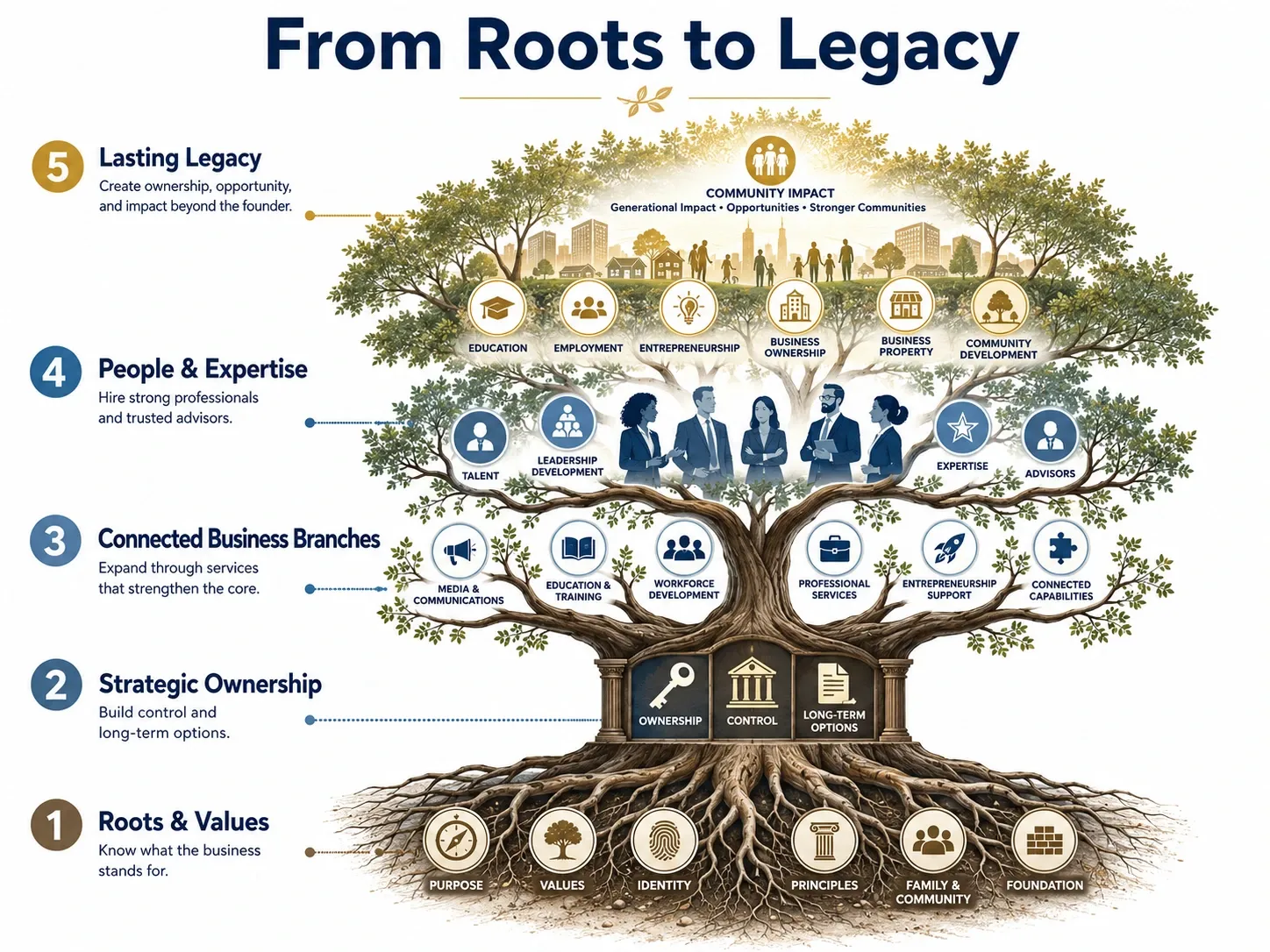
Five Lessons Entrepreneurs Can Use to Build a Business Legacy
Vonnya’s journey offers a practical framework for business owners who want their work to create something that lasts.
1. Start With Roots and Values
Know what matters before deciding how large the business should become. Values give growth direction and help owners decide which opportunities fit.
2. Own Where It Makes Strategic Sense
Ownership can create control and optionality, but it should be evaluated in the context of financing, cash flow, risk, business concentration, and long-term objectives.
3. Build Branches That Strengthen the Core
New services should ideally connect to the same capabilities, audience, mission, or infrastructure rather than simply adding complexity.
4. Invest in People and Professional Expertise
A founder cannot sustainably remain the only person capable of making every important decision. Experienced employees and qualified outside advisors can help the business mature.
5. Define Legacy More Broadly Than an Exit
Legacy may include ownership, jobs, education, apprenticeships, community investment, intellectual property, institutions, or opportunities that remain after the founder steps away.
The FiduciWho Short Share When You're Ahead reinforces another piece of Vonnya’s philosophy: knowledge and success do not have to be guarded as scarce resources. Sharing what works can create stronger networks and stronger businesses around you.
Legacy Does Not Require a Traditional Family Script
Legacy conversations are often framed around children and inheritance. Vonnya openly describes a different model.
As a single woman without children, she defines legacy through the people, communities, businesses, and industries changed by the work she creates.
That is an important reminder for financial planning as well. Legacy is personal.
For one person, legacy may mean creating financial security for children and grandchildren. For another, it may mean supporting a charitable organization, mentoring future leaders, building a company that provides jobs, creating educational opportunities, owning property that anchors a neighborhood, or preserving a body of work that continues to influence people.
There is no requirement that somebody else’s definition of legacy become yours.
The planning work is to decide what you actually want to continue and then determine what financial, legal, business, and organizational structures may be needed to support it.
That is where the protect, grow, enjoy, and transfer framework becomes especially useful. Protect what makes the mission possible. Grow the resources thoughtfully. Enjoy what you have created while you are here. Then transfer assets, responsibilities, opportunities, or values in a way that reflects your intentions.
An Abundance Mindset Can Become a Business Advantage
Another quality that came through clearly in my conversation with Vonnya was her willingness to share.
Some people treat knowledge as something to guard. They worry that if they explain the playbook, somebody else will take their opportunity. Vonnya approaches business differently.
She participates in communities where entrepreneurs and CEOs exchange ideas, relationships, lessons, and resources. Her belief is that when builders help one another understand what works, everybody becomes stronger.
There is practical value in that mindset. A strong network can expose an owner to new financing ideas, better professionals, different operating systems, fresh perspectives, and opportunities the founder may never have discovered alone.
It can also challenge blind spots.
Entrepreneurship can become isolating when every important decision stays inside one person’s head. The right peer group or professional network creates a place to test assumptions before those assumptions become expensive.
Sharing also strengthens the broader entrepreneurial ecosystem. When experienced business owners teach, mentor, collaborate, hire, refer, and invest in others, opportunity can multiply rather than remain concentrated.
Final Thoughts
Dr. Vonnya Pettigrew’s story begins with roots, but it does not end there.
Those roots became a media company. The media company became an educational platform. Education expanded into workforce development. Business growth created the opportunity for property ownership. That ownership created a larger platform for community, entrepreneurship, and long-term impact.
That is what building a business legacy can look like when growth and purpose remain connected.
The numbers still matter. Financing matters. Cash flow matters. Contracts matter. The right CFO, attorney, banker, financial professional, and business advisors matter. But the life behind those numbers matters more.
Your dreams matter, and your future is our priority. If you are building a company or thinking about what you want your success to make possible, consider defining the legacy first. Then work backward into the ownership, people, financial resources, protection, and planning that may be needed to support it.
Qualified financial, tax, legal, real-estate, and business professionals can help you evaluate those decisions based on your circumstances and the risks involved.
Frequently Asked Questions
What does building a business legacy mean?
Building a business legacy means creating value that can continue beyond the founder. That may include ownership, jobs, intellectual property, community impact, educational opportunities, financial assets, or an organization that can continue serving people in the future.
Why can business ownership matter for legacy planning?
Ownership can create greater control over assets, operations, and future decisions. Depending on the situation, owning a business or commercial property may also create long-term options that can support succession, community impact, or other legacy goals.
How can entrepreneurs grow without losing their original mission?
Entrepreneurs can begin by defining the values and purpose of the business, then evaluating whether new services, hires, partnerships, and investments strengthen that core mission rather than simply adding more activity.
Does a legacy have to be passed to children?
No. Legacy can take many forms. It may involve family wealth, but it can also include philanthropy, mentorship, community investment, business ownership, education, jobs, creative work, or institutions that continue creating value for others.
Why should business owners use outside advisors as they grow?
Growth introduces decisions involving areas such as financing, contracts, taxes, real estate, staffing, risk, and succession. Qualified professionals can provide specialized expertise and help owners evaluate choices they may not have encountered before.
How does building a business legacy connect to financial planning?
Financial planning can help connect business ownership, personal wealth, risk management, retirement, property, succession, and legacy goals so the owner can better understand how business decisions support the life and impact they want to create.