


Selling a home may be one of the largest financial transactions a family completes. Yet many homeowners spend more time comparing paint colors and staging ideas than understanding who will represent them, how their property will be marketed, and what incentives may influence the people involved in the transaction.
On FiduciWho, I spoke with Michael Bell, the top-ranked residential broker with Sotheby’s International Realty in Pasadena and author of the Wall Street Journal bestseller Seller Mistakes. Michael has closed more than $500 million in residential real estate transactions and ranks among the top 0.1% of agents nationwide.
Those accomplishments are impressive, but what stood out most was his focus on fiduciary responsibility. His position is straightforward: when homeowners sell what may be their largest asset, they deserve to understand who represents them and whether that professional is able to advocate exclusively for their interests.
Your dreams matter, and your future is our priority. Protecting that future begins with asking better questions before signing an agreement, not after a problem appears.
Quick Answers
What is dual agency in real estate? Dual agency occurs when the same real estate agent represents both the seller and the buyer in one transaction. Rules vary by jurisdiction, and disclosure may be required where the practice is permitted.
Why can dual agency create a conflict? A seller generally wants the highest reasonable price and strongest terms, while a buyer generally wants the lowest reasonable price and most favorable terms. Representing both positions can limit how exclusively an agent advocates for either party.
What should sellers ask a listing agent? Sellers should ask how the agent handles representation, pricing, marketing, communication, negotiations, competing offers, and potential conflicts of interest.
Do open houses and yard signs sell homes? They may contribute to exposure, but Michael Bell argues that accurate pricing, professional marketing, broad market reach, communication, and skilled negotiation have a greater effect on the seller’s outcome.
Why should homeowners interview more than one agent? Agents may differ significantly in their representation policies, strategy, experience, communication standards, and approach to negotiation.
Why Representation Matters When You Sell a Home
A home is more than a building. It may represent years of mortgage payments, improvements, memories, and accumulated equity. For many families, it is also one of the largest assets on their balance sheet.
That makes representation a financial issue, not merely a sales issue.
A listing agent may advise on pricing, marketing, offer terms, disclosures, negotiations, timing, and the risks attached to different decisions. The seller must be able to understand whose interests that professional is responsible for advancing.
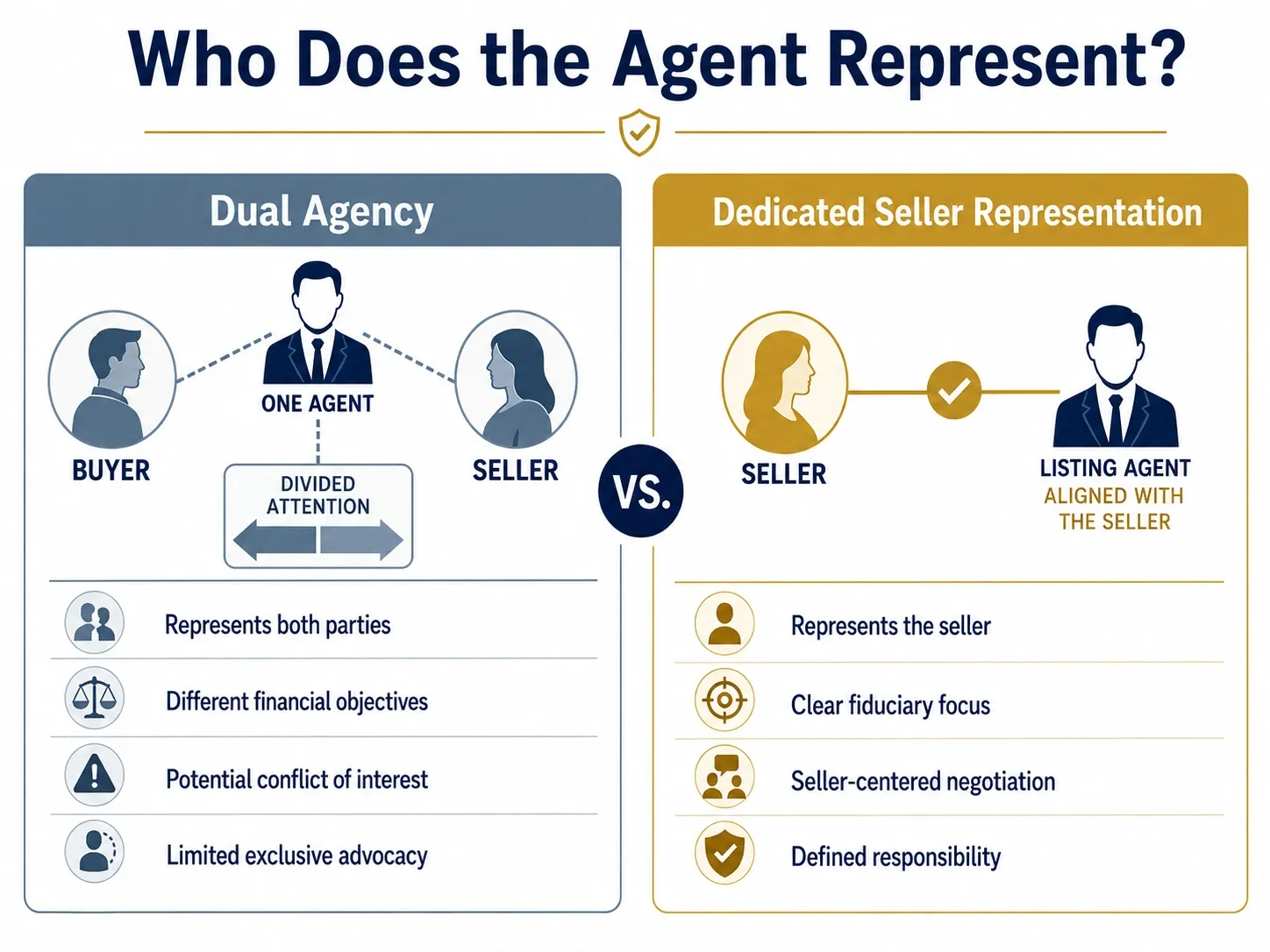
Michael’s practice is based on what he calls single-party seller representation. He represents the seller rather than attempting to represent both sides of the transaction. His reasoning is that a fiduciary should have one client and one clear responsibility.
This principle closely reflects the broader idea behind protecting your wealth before concentrating on growth. Home equity can be a meaningful part of a family’s wealth, and protecting it requires clarity about incentives, obligations, and representation.
The FiduciWho Short explaining why the first step is protection rather than growth is relevant here because a successful sale begins by protecting the seller’s position before focusing on the final number.
Dual Agency in Real Estate and the Problem of Divided Loyalty
Dual agency occurs when one agent represents the buyer and seller in the same real estate transaction. Michael believes that arrangement creates an inherent conflict because the parties enter the negotiation with different objectives.
The seller may want the highest price, the strongest financing, the fewest contingencies, and a dependable closing. The buyer may want a lower price, more concessions, favorable contingencies, and flexibility. Both positions can be reasonable, but they are not the same position.
When one professional attempts to serve both sides, difficult questions arise. How aggressively can that person negotiate for the seller without working against the buyer? How candidly can the agent discuss pricing, urgency, leverage, or acceptable terms with either client?
Michael also believes that buyers may compete more confidently when they know the listing agent is not attempting to represent them. A clearly defined process can create a more level playing field and encourage qualified buyers to submit their strongest terms.
Real estate agency laws and disclosure requirements differ by state and transaction. Homeowners should review applicable agreements carefully and seek guidance from qualified real estate and legal professionals when they have questions about representation.
Real Estate Marketing Myths Sellers Should Question
Many homeowners assume that agents market properties in essentially the same way. They expect a sign in the yard, an open house, online photos, and perhaps a print advertisement. Because those activities are visible, they can feel like proof that the agent is working.
Michael challenges that assumption.
He argues that open houses often produce leads for agents more effectively than they produce buyers for the specific property. Yard signs and print advertisements may create awareness, but he believes their direct influence on the final sale is often smaller than homeowners expect.
The more important questions concern strategy:
- Is the property presented professionally?
- Is the pricing supported by market evidence?
- Is the home exposed broadly to qualified buyers?
- Does the marketing communicate the property’s value clearly?
- Is there a plan for reviewing interest and encouraging competition?
- Can the agent explain how each marketing activity supports the seller’s objective?
Marketing should not be a collection of visible tasks. It should be a coordinated process designed around the property, the market, and the seller’s goals.
That distinction resembles the broader planning lesson discussed in Jesse Cramer: Smart Planning Beats Smart Investing. Activity can look impressive, but a thoughtful strategy matters more than checking boxes.
Pricing Is a Process, Not Just a Number
Homeowners naturally pay close attention to the list price. It is visible, easy to compare, and emotionally significant. But Michael believes a pricing strategy should do more than produce an attractive number on a listing agreement.
The goal is to create a process that allows the market to respond.
An unsupported high price can reduce interest, extend the listing period, and weaken the seller’s negotiating position. A disciplined price supported by market evidence may attract more qualified attention and produce stronger competition.
When multiple buyers are interested, Michael favors a structured bidding process rather than rushing to accept the first strong offer. Giving qualified buyers a fair opportunity to participate may improve price, financing quality, contingencies, closing terms, and overall reliability.
The highest offer is not automatically the strongest offer. A seller may also need to evaluate financing, appraisal exposure, inspection terms, timing, contingencies, deposits, and the probability that the transaction will close.
This is where experience can matter. Most homeowners complete only a few real estate transactions in their lifetime. An experienced professional has observed how different terms, buyer behaviors, market conditions, and negotiation decisions can affect an outcome.
How to Interview a Real Estate Agent Before Hiring One
Michael cited industry research indicating that approximately 75% of home sellers interview only one agent before making a decision. He encourages homeowners to interview multiple professionals because representation, communication, and strategy can differ considerably.
The goal is not to create an exhausting selection process. It is to understand how each agent would protect and advance the seller’s interests.
Ask About Representation
Will the agent represent only you, or could the agent also represent the buyer? What happens if an unrepresented buyer contacts the listing agent directly? How are conflicts disclosed and handled?
Ask About Pricing
What evidence supports the recommended price? How will the agent respond if buyer interest is weaker or stronger than expected? Is the strategy designed to create competition or simply win the listing presentation?
Ask About Marketing
Which activities are designed to attract buyers for the property, and which primarily promote the agent? How will the home be presented, distributed, and differentiated?
Ask About Communication
How often will the agent communicate? Who will be the seller’s primary contact? How quickly will questions be answered? What information will be provided after showings and during negotiations?
Ask About Negotiation
How does the agent evaluate multiple offers? How will price and non-price terms be compared? What process will be used to encourage qualified buyers to improve their proposals fairly?
Hiring a professional for a major financial decision should involve more than choosing the first person who makes a confident presentation. The FiduciWho Short about how to hire the right financial advisor focuses on a different profession, but the underlying lesson is similar: understand the person’s obligations, process, incentives, and approach before placing trust in them.
Trust and Communication Still Drive Real Estate
Technology has changed how homes are photographed, promoted, discovered, and toured. It has not eliminated the importance of relationships.
Michael explained that much of his business comes from referrals and long-standing relationships. That makes sense. People do not recommend a professional merely because that person used a certain advertising platform. They make referrals because they felt heard, informed, represented, and respected.
Communication is a major part of that trust. Sellers want to know what is happening, what comes next, what choices are available, and how each decision could affect the outcome. Silence creates uncertainty. Clear communication gives people the context they need to make informed decisions.
The FiduciWho Short explaining why trust is a powerful asset fits naturally here. Trust does not replace competence, but competence is far more valuable when clients can rely on the professional’s communication, judgment, and loyalty.
That principle also appears in Emma Hall’s conversation about integrity and financial clarity. Whether someone is selling a home or planning a financial future, clarity and trust make complicated decisions more manageable.
Success Should Be Measured Beyond the Transaction
Toward the end of our conversation, Michael shared another part of his work that made an impression on me.
Through an organization called Sell a Home, Save a Child, he contributes a portion of his commissions to programs that help provide food, clean water, and opportunities to children in underserved communities around the world.
That commitment reinforces an important point: success is not measured only by the number of transactions completed or dollars earned. It is also measured by the responsibility we accept, the trust we earn, and the positive impact we create.
Money is a tool. It can provide security and freedom, but it can also support family, purpose, generosity, and meaningful work. The numbers matter, but the life behind the numbers matters more.
What Homeowners Can Do Before Signing a Listing Agreement
Before selecting an agent, slow the process down long enough to understand the relationship you are creating.
Interview more than one professional. Ask who will represent whom. Review how the property will be priced and marketed. Understand how offers will be compared. Establish expectations for communication. Read the agency and listing documents carefully, and ask qualified professionals to explain provisions you do not understand.
Do not assume every real estate professional follows the same process or accepts the same fiduciary responsibility. A polished presentation is not a substitute for clear representation.
If a home represents a meaningful part of your net worth, consider how the transaction fits into your larger financial plan. The sale may affect cash flow, taxes, retirement timing, estate planning, housing decisions, debt, and future investment choices. Real estate, legal, tax, and financial professionals can help evaluate those issues within their respective areas of expertise.
Good planning is not about guessing the future. It is about preparing for it. Before you sign a listing agreement, make sure you understand the strategy, the incentives, and the person responsible for protecting your interests.
Final Thoughts
Michael Bell’s message is clear: selling a home successfully is not simply about placing the property on the market and waiting for an offer. It requires thoughtful representation, disciplined pricing, professional exposure, skilled negotiation, and consistent communication.
Dual agency in real estate deserves particular attention because sellers should understand whether the person advising them is also responsible for the buyer. When interests differ, clarity about representation matters.
At Raskin Global, we help families and business owners think about how to protect, grow, enjoy, and transfer their wealth. Home equity can be an important part of that picture. Protecting it begins with informed decisions and professionals who clearly understand whose interests they are serving.
If you are preparing to sell a home, consider reviewing your listing strategy within the context of your broader financial life. Speak with qualified real estate, financial, legal, and tax professionals before making decisions that depend on your individual circumstances.
Frequently Asked Questions
What is dual agency in real estate?
Dual agency occurs when one real estate agent represents both the buyer and seller in the same transaction. Laws and disclosure requirements vary by jurisdiction, so homeowners should review local rules and their agency agreements carefully.
Why can dual agency be a conflict of interest?
The buyer and seller usually have different financial and contractual objectives. When one agent represents both parties, the agent may be limited in how exclusively that person can negotiate or advise on behalf of either client.
What is single-party seller representation?
Single-party seller representation means the listing agent represents the seller rather than both parties. The agent’s responsibility is focused on advocating for the seller’s interests within the applicable legal and contractual framework.
How many real estate agents should a seller interview?
There is no required number, but interviewing multiple qualified agents can help a seller compare representation policies, pricing strategies, marketing plans, communication standards, experience, and negotiation approaches.
Is the highest real estate offer always the best offer?
No. Sellers may also need to evaluate financing, contingencies, appraisal risk, inspection terms, deposits, closing timelines, and the likelihood that the buyer can complete the transaction.
How does selling a home relate to financial planning?
A home sale may affect cash flow, taxes, retirement, estate planning, future housing, debt, and investment decisions. Reviewing the transaction within a broader financial plan can help families understand the tradeoffs and prepare for what comes next.