


Some of the hardest financial lessons come from discovering that intelligence and complexity are not the same as good judgment. Victor Haghani knows that firsthand. As the founder of Elm Wealth and one of the original partners at Long-Term Capital Management, he spent years surrounded by sophisticated models, respected investors, and some of the brightest minds in finance.
Yet when Victor stepped away from Wall Street and focused on managing his family’s wealth, he encountered a challenge many families know well: there were plenty of products and opinions, but very little clarity. His experience eventually led him back to a simpler foundation—broad diversification, low costs, transparency, tax awareness, and disciplined asset allocation.
That foundation became what Victor calls dynamic index investing. It starts with index funds, but it does not end there. It recognizes that every investor must make active decisions about how much to hold in stocks, bonds, real estate, cash, and other assets. The objective is not to predict tomorrow’s headlines. It is to follow a rational process that can respond to changing risk and expected returns without being controlled by fear or excitement.
That distinction matters because money should serve your life—not the other way around. The numbers matter, but the life behind those numbers matters more.
Key Takeaways
- Dynamic index investing is more than owning index funds. It combines low-cost investments with deliberate, adaptable asset allocation.
- No portfolio allocation is truly passive. Someone must decide how much to invest in each asset class and when that mix should change.
- Evidence should lead; emotion should not. Decisions should reflect measurable risks, expected returns, personal goals, and financial capacity.
- Complexity is not automatically sophistication. A transparent strategy that can be understood and maintained may be more useful than an elaborate collection of investments.
- Consistency supports long-term wealth. Costs, taxes, diversification, discipline, and behavior can all influence whether a financial plan succeeds.
What Is Dynamic Index Investing?
Dynamic index investing is an investment approach that uses broad, low-cost index funds while adjusting asset allocation as relevant risks and expected returns change. The word dynamic does not mean constant trading. It means the portfolio is not treated as if the original allocation must remain unchanged forever, regardless of markets or the investor’s circumstances.
The approach begins with a few practical principles:
- Own broadly diversified, low-cost index funds.
- Evaluate expected returns using underlying cash flows rather than market excitement.
- Consider increasing exposure when expected returns are more attractive relative to risk.
- Reduce exposure when risk becomes unusually high or no longer fits the investor’s plan.
- Keep implementation transparent, understandable, and attentive to taxes.
This is not a promise of superior returns, nor is it a shortcut around uncertainty. Investing always involves risk. Dynamic index investing is better understood as a decision framework: a way to organize choices without pretending that anyone can know the future with certainty.
For a broader discussion of Victor’s perspective, our article on Victor Haghani and smarter decisions through dynamic index investing provides additional context for the philosophy behind the approach.
Why Passive Funds Do Not Create a Passive Portfolio
An index fund can passively track a market benchmark. Your total portfolio, however, cannot decide its own purpose or allocation.
Someone still has to determine how much belongs in stocks, bonds, cash, real estate, or other holdings. Someone must also decide whether the portfolio is designed for near-term spending, retirement income, family security, business liquidity, charitable giving, or a future transfer to the next generation.
Those are active decisions, even when every underlying investment is an index fund.
This is why the argument between “active” and “passive” investing can miss the most important question. The real issue is not simply whether a fund tracks an index. It is whether the overall allocation fits the investor’s goals, time horizon, liquidity needs, risk capacity, and ability to stay committed when markets become uncomfortable.
A portfolio can be inexpensive and diversified but still be poorly matched to the person who owns it. Good financial planning connects the investments to the life they are expected to support.
A Practical Dynamic Index Investing Framework
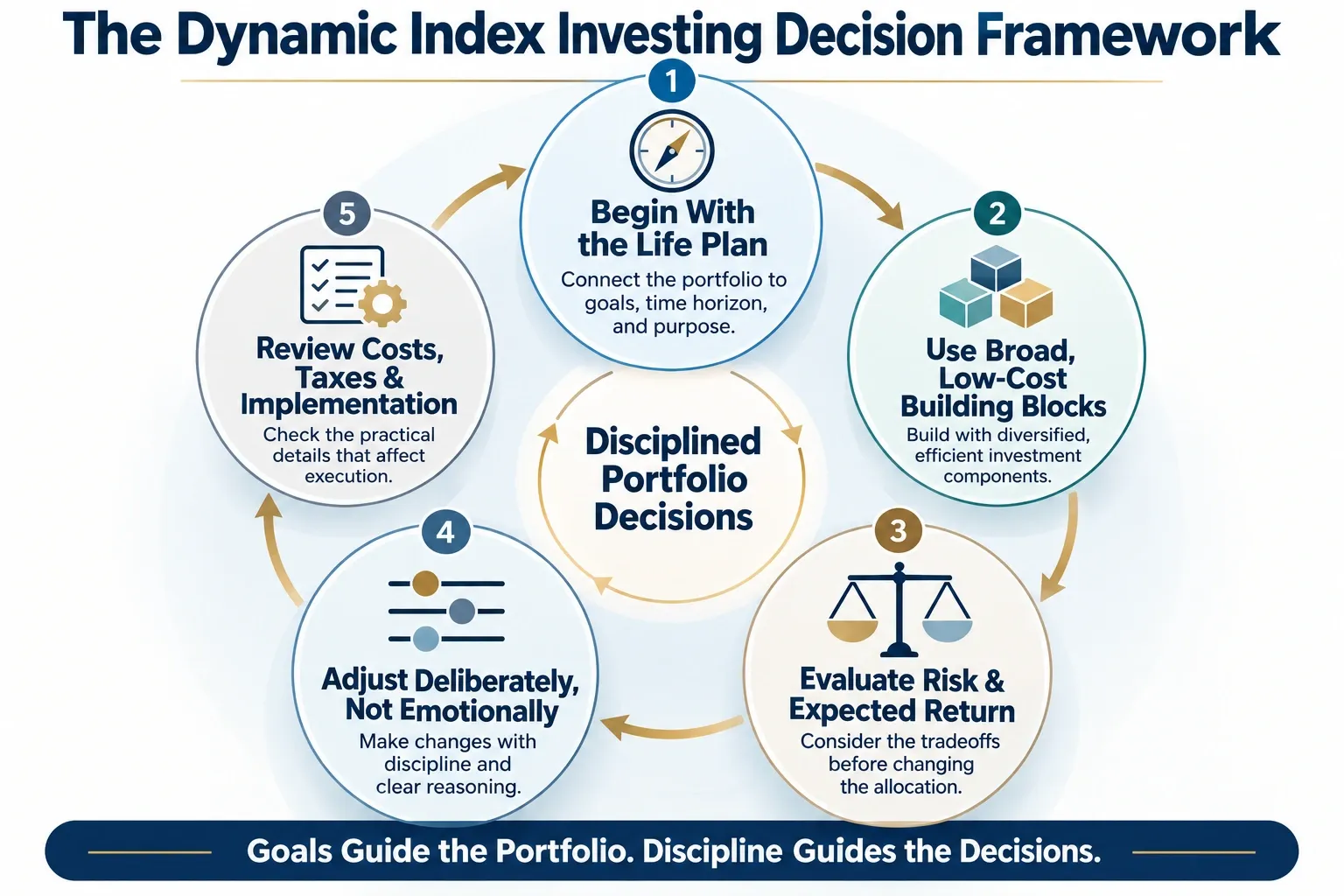
A useful investment process should be clear enough to explain and disciplined enough to follow. Victor’s framework can be organized into five practical steps.
1. Begin With the Life Plan
Before choosing an allocation, define what the money needs to accomplish. A family funding retirement income has different needs from a business owner preparing for a future transition. Time horizon, required cash flow, family responsibilities, and emotional comfort all belong in the conversation.
2. Use Broad, Low-Cost Building Blocks
Broad index funds can provide diversified exposure without requiring an investor to identify individual winners. Keeping costs under control also leaves more of the portfolio working toward the investor’s goals.
3. Evaluate Risk and Expected Return
Expected returns should be considered in relation to underlying economics and current risk—not social media excitement, recent performance, or the fear of missing out. These estimates are imperfect, but a consistent process can be more useful than reacting to every headline.
4. Adjust Deliberately, Not Emotionally
A dynamic approach may adjust exposure when the relationship between risk and expected return changes materially. That is different from chasing markets. Changes should follow predetermined principles and remain consistent with the investor’s financial plan.
5. Review Costs, Taxes, and Implementation
A promising strategy can be weakened by unnecessary fees, avoidable tax consequences, poor account placement, or excessive trading. Tax considerations are personal and can be complicated, so decisions should be reviewed with qualified financial and tax professionals.
The central lesson is simple: build a process before pressure arrives. As the FiduciWho Short “Everyone Thinks They’re Comfortable With Risk Until It Shows Up Uninvited” explains, stated risk tolerance can look very different once markets become genuinely uncomfortable.
Why Smart Investors Still Make Poor Decisions
Financial knowledge does not make anyone immune to overconfidence, fear, impatience, or speculation. In some cases, knowing more can create the dangerous belief that every market move can be anticipated or outsmarted.
Today, investing decisions can be made in seconds. Zero-commission trading, social media communities, nonstop financial commentary, and enthusiasm surrounding new technologies can make speculation feel like a disciplined plan. It is still speculation when the decision is driven by excitement rather than a defined process.
The FiduciWho Short “You Can’t Outsmart the Market” reinforces the point: trying to win through constant prediction can distract investors from the fundamentals they can actually control.
Those controllable factors include:
- How much you save
- How broadly you diversify
- How much risk you take
- What you pay in fees
- How tax-aware your decisions are
- How consistently you follow your plan
Evidence over emotion. Risk management over guesswork. Discipline over drama. That does not eliminate losses or uncertainty, but it can reduce the likelihood that temporary emotion turns into a permanent financial mistake.
How Complexity Can Work Against Investors
Victor’s turning point came after years of using sophisticated investments, including hedge funds, private equity, and alternatives. The result was not the clarity he expected. Instead, he encountered paperwork, capital calls, and tax inefficiencies. In 2006, a conversation with his accountant about a substantial tax obligation—despite Victor’s sense that he had not made much that year—forced him to reconsider the structure of his financial life.
The lesson is not that every private investment or alternative strategy is automatically inappropriate. The lesson is that complexity carries costs. Those costs may include higher fees, reduced liquidity, administrative burdens, difficult tax reporting, and less visibility into what the portfolio actually owns.
An investment should not earn a place in a portfolio merely because it sounds sophisticated. It should have a clear role, understandable risks, and a reasonable connection to the investor’s goals.
This is also why planning should come before product selection. Our conversation with Jesse Cramer on why smart planning can matter more than smart investing explores the same essential idea: investments work best when they serve a coherent financial plan.
Connect the Portfolio to the Life Behind It
A technically sound portfolio is only one part of financial readiness. Families must also consider how their investments fit with retirement income, emergency reserves, insurance protection, tax planning, estate documents, business interests, and family responsibilities.
Emotional readiness matters too. If a strategy is so aggressive that you cannot sleep during a decline, it may not be sustainable. If it is so conservative that it cannot reasonably support your long-term goals, that creates another kind of risk. The right balance is personal and deserves more thought than a generic online questionnaire.
At Raskin Global, we often describe planning through four connected responsibilities:
- Protect wealth from risks that could disrupt the plan.
- Grow wealth with disciplined, goal-aligned decisions.
- Enjoy wealth by using it to support family, freedom, purpose, and meaningful experiences.
- Transfer wealth thoughtfully to the people and causes that matter.
Dynamic index investing can support that larger process, but it is not a substitute for it. A family’s portfolio should be coordinated with the rest of its financial life.
If you are uncertain whether your current allocation, costs, tax exposure, and risk level work together, consider reviewing them with qualified financial, tax, and legal professionals. The purpose is not to add complexity. It is to gain enough clarity to make informed decisions.
Consistency Is More Valuable Than Excitement
Investing rarely rewards the constant search for excitement. A strong process may look ordinary from the outside: save consistently, diversify broadly, manage costs, review taxes, rebalance thoughtfully, and avoid decisions driven by headlines.
That does not mean setting a portfolio once and ignoring it forever. Lives change. Markets change. Businesses are sold, careers end, families grow, health needs develop, and retirement priorities evolve. A sound plan should be reviewed when circumstances change and at reasonable intervals even when they do not.
The goal is not activity for activity’s sake. It is purposeful adjustment. Great wealth is not necessarily built through complexity. More often, it is supported by consistent behavior and a process that can survive both good markets and difficult ones.
This is where professional guidance can be useful—not as a source of predictions, but as a source of structure, perspective, coordination, and accountability.
Final Thoughts
Victor Haghani’s experience offers a grounded reminder: even highly intelligent investors can become lost in complexity. Clarity comes from understanding what you own, why you own it, what risks you are taking, and how each decision supports the life you want.
Dynamic index investing brings together broad diversification, low costs, adaptable asset allocation, tax awareness, and disciplined decision-making. It cannot remove uncertainty, but it can provide a rational framework for navigating it.
Your dreams matter, and your future should remain the priority. Investments are tools—not the destination. Used thoughtfully, they can help you protect, grow, enjoy, and ultimately transfer your wealth with greater purpose.
If your portfolio feels more complicated than clear, start by asking what every holding is expected to accomplish. Then consider reviewing the full plan with qualified professionals who can evaluate your circumstances, goals, risks, and tax considerations. This article is educational and is not individualized investment, tax, legal, or insurance advice.
Frequently Asked Questions
What is dynamic index investing?
Dynamic index investing uses broad, low-cost index funds while allowing asset allocation to adjust as expected returns, market risks, and the investor’s circumstances change. Adjustments follow a disciplined process rather than short-term predictions or emotional reactions.
Is dynamic index investing the same as market timing?
No. Market timing generally attempts to predict short-term market movements. Dynamic index investing focuses on measured changes in risk, expected return, and personal financial needs without assuming that near-term market direction can be known with certainty.
Can an index fund portfolio be completely passive?
The funds can passively track indexes, but the overall portfolio still requires active decisions. Someone must choose the mix of stocks, bonds, cash, and other assets and determine whether that allocation continues to fit the investor’s goals and risk capacity.
Why do investment costs and taxes matter?
Fees and taxes can reduce the amount of wealth available for future goals. Their effects vary by investment, account type, holding period, and personal circumstances, so implementation should be reviewed with qualified financial and tax professionals.
How often should an investment allocation be reviewed?
An allocation should be reviewed periodically and when meaningful changes occur in goals, cash-flow needs, family circumstances, business ownership, retirement timing, or risk capacity. A review does not automatically mean that a change is necessary.