


Sales and fiduciary responsibility may sound like two different worlds. One is usually associated with revenue, pipelines, and prospects. The other is associated with putting somebody else’s interests first.
But my conversation with Doug C. Brown, CEO of CEO Sales Strategies, reminded me how closely the two can be connected when business is done well. Doug’s approach to an ethical sales strategy starts with a simple question: What is actually best for the client?
If the answer is that your product or service is not the right fit, you should be willing to say so. If the relationship is right, then your responsibility is to communicate clearly, follow through consistently, understand the numbers, and build a process that does not depend on somebody remembering to make one heroic phone call at exactly the right moment.
That sounds a lot like fiduciary thinking to me. Trust is not created by a slogan. It is created by what happens repeatedly when nobody is looking.
Your dreams matter, and your future is our priority. Whether we are talking about financial planning or business growth, clarity should come before complexity. Know whom you serve, know what you are trying to accomplish, measure what matters, and build a process people can trust.
Quick Answers
What is an ethical sales strategy? An ethical sales strategy puts client fit and long-term value ahead of forcing a transaction. It combines honest qualification, clear communication, disciplined follow-up, and measurable processes.
Why are sales systems more important than closing tactics? A system helps a team consistently identify prospects, qualify opportunities, follow up, measure results, and improve weak points. A closing technique affects only one part of that process.
Why does sales follow-up matter so much? Follow-up protects opportunities from being lost through inattention. Consistent communication also shows prospects and clients that care is supported by a process rather than left to memory.
Which sales metrics should a business track? Doug emphasizes ratios such as lead-to-qualified opportunity, yes-versus-no outcomes, churn, and referrals. The right metrics help identify where momentum is being lost.
Why can prospecting be more valuable than mastering the close? Consistent prospecting creates a healthier flow of potential right-fit clients. Strong closing skills have limited value when there are too few qualified opportunities entering the pipeline.
Why Ethical Sales Strategy Starts With Client Fit
Doug made a point that immediately connected with the way I think about fiduciary work: every interaction should feel client-first, even when your industry does not legally require a fiduciary standard.
The starting question is not, “How do I get this person to say yes?” It is, “Should this person say yes at all?”
That distinction changes everything.
If the product, service, timing, budget, or relationship is wrong, trying to force the transaction may create revenue today and a problem tomorrow. Churn increases. Trust erodes. Referrals disappear. Employees end up managing expectations that should never have been created.
Sometimes the right decision is to disengage.
That does not mean avoiding sales. It means understanding that the best customer relationship begins with honest qualification. The client should benefit from saying yes, and the company should be capable of delivering what it promised.
The FiduciWho Short about how you should earn trust first, create value second, and let revenue follow reinforces the same principle. Revenue matters, but trust is what gives revenue durability.
There is a similar lesson in Emma Hall’s conversation about integrity and financial clarity. Whether the relationship involves financial advice or a business purchase, people deserve to understand what they are agreeing to and why it may or may not serve their interests.
Sales Systems Beat Isolated Closing Techniques
Sales training often focuses on tactics: the perfect question, the perfect objection response, or the perfect closing line.
Techniques can be useful. Doug’s point is that they belong inside a system.
His Double Your Sales methodology is built around goals, ratios, benchmarks, and diagnosis. Instead of assuming every sales problem is a closing problem, the business looks at the entire process and asks where momentum is actually slowing down.
That is a much better management question.
A company may have plenty of leads but very few qualified prospects. Another may qualify prospects effectively but lose them during follow-up. A third may close business but experience high churn because the wrong customers were brought in to begin with.
You cannot solve those problems with the same tactic because they are not the same problem.
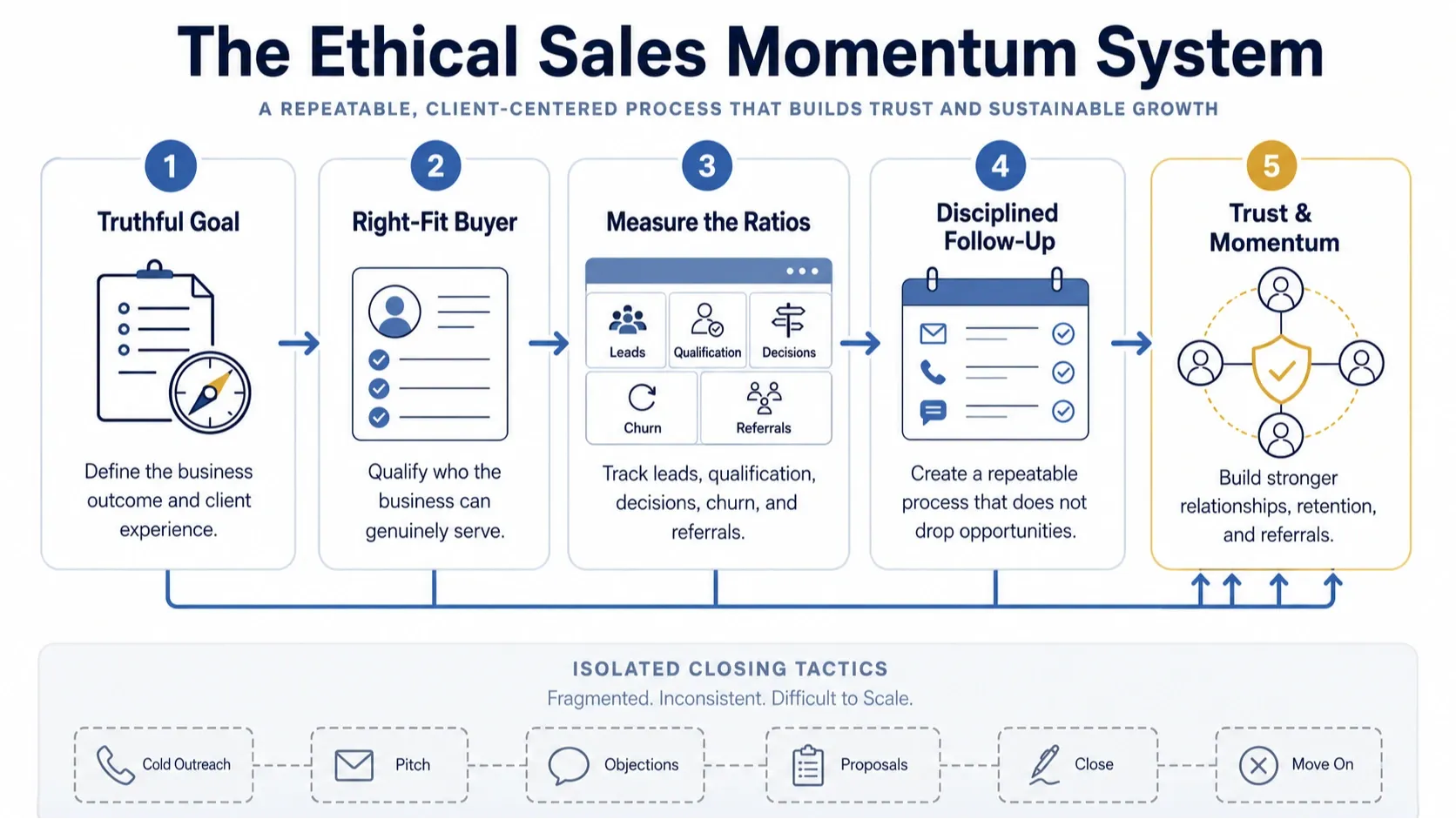
Doug’s framework begins with three practical disciplines:
- Define a truthful goal. Know what the business is trying to accomplish and what kind of experience it intends to create for the client.
- Know the right-fit buyer. Be clear about whom the company can genuinely serve well.
- Track the ratios. Measure what happens from initial lead through qualification, decision, retention, and referral.
Financial planning works the same way. We do not improve a plan by randomly changing whatever investment or strategy happens to be getting the most attention. We first identify the objective, examine the numbers, understand the weak point, and then determine whether an adjustment is appropriate.
That connection is why Jesse Cramer’s message that smart planning beats trying to look smart is relevant here. A repeatable process is usually more useful than a collection of clever moves.
Follow-Up Is Care Made Operational
One of Doug’s most practical lessons came from a painful experience. A breakdown in follow-up cost him a major commission.
The story matters because almost every business says it cares about its clients. The real question is whether the company has a system capable of demonstrating that care consistently.
If a promising prospect receives a thoughtful conversation and then hears nothing for weeks, the original conversation matters a lot less. If an existing client has a question and nobody knows who is responsible for responding, the relationship becomes vulnerable.
Care cannot depend entirely on memory.
In financial planning, the equivalent might be allowing an important review, beneficiary discussion, or planning follow-up to disappear because somebody assumed somebody else was handling it. The specifics are different, but the operational lesson is the same: important responsibilities need an owner and a process.
Good follow-up should still feel personal. Systems are not an excuse to automate every human interaction into a generic message. The system should make sure the right person receives the right communication at the right stage without losing the relationship in the machinery.
That is also why Doug’s existing conversation about follow-up, trust, and sales that scale fits naturally with this lesson. Growth becomes fragile when important relationships depend on somebody remembering everything manually.
Prospecting Creates More Durable Momentum Than Closing Tricks
Doug offered one line that should get the attention of every sales leader: a master prospector will outperform a master closer.
Why?
Because somebody who is excellent at closing cannot close opportunities that never enter the pipeline.
A consistent prospecting process creates more chances to meet right-fit clients, learn what the market is saying, improve qualification, and build relationships before there is pressure to complete a transaction.
It also reduces desperation.
When the pipeline is empty, every opportunity can start to look like the right opportunity. That is exactly when ethical standards are most likely to be tested. The business wants the revenue badly enough that qualification standards begin to move.
A healthy pipeline gives the organization more freedom to say, “This is not the right fit,” because one individual transaction does not feel like the entire season.
As a Ravens fan, I understand the football analogy. You do not build a winning year around one miracle play. First downs matter. Repetition matters. Field position matters. A lot of ordinary, disciplined execution eventually creates extraordinary results.
The FiduciWho Short about why you need to talk to more people connects directly with this idea. Consistent conversations expand opportunity while helping the business learn which relationships truly fit.
Sales Metrics Turn Guesswork Into Diagnosis
Doug’s approach puts math at the center of sales management.
Not because every client relationship can be reduced to a spreadsheet, but because ratios tell you where to ask better questions.
Consider a few examples.
If a company generates plenty of leads but few become qualified opportunities, the issue may be targeting or qualification. If qualified prospects move forward but rarely say yes, the offer, communication, pricing, or fit may deserve attention. If clients buy and quickly leave, the problem may be expectations, delivery, or initial qualification. If clients stay but rarely refer others, the business may need to examine whether the experience is truly distinctive.
Without the ratios, leaders can easily spend time fixing the wrong thing.
This principle extends far beyond sales. Business owners need to know the numbers that explain how the company actually works. Financial professionals need to understand the numbers behind a plan rather than relying on impressions. Investors need to understand the economics beneath a business rather than just looking at a story.
Our FiduciWho Short on why owners should know their costs reinforces the broader lesson: what you do not measure clearly becomes harder to manage intelligently.
Metrics do not replace judgment. They improve the questions judgment can ask.
Trust Is Built Through Process, Not Promises
There is a tendency in business to talk about trust as if it were a personality trait. Somebody is trustworthy because they are friendly, experienced, confident, or sincere.
Those things matter, but long-term trust is more demanding.
Trust is built when the business consistently does what it said it would do. It qualifies honestly. It communicates. It follows up. It admits when something is not a fit. It keeps the client’s interests in view even when a different decision might produce faster revenue.
That is why Doug’s client-first sales philosophy sounds so familiar to me.
Real fiduciary thinking means the relationship cannot be built around what benefits the professional first. In financial planning, that responsibility has specific legal and regulatory meanings depending on the professional and the engagement. In sales, Doug is using the idea as an ethical operating standard: begin with the client’s best interest and be willing to walk away when the fit is wrong.
The FiduciWho Short Trust Is a Powerful Asset captures the business value of that principle. Trust may not appear as a line item on the balance sheet, but losing it can affect retention, referrals, reputation, and future opportunity.
For another perspective on keeping client interests and professional integrity at the center of the relationship, John Kailunas’s conversation about independence and integrity in financial advice provides a useful parallel.
Par Can Be a Great Score in Sales, Investing, and Business
Doug and I also talked about golf, where a disciplined par can be a phenomenal result when everybody else is making mistakes.
That is a useful analogy for investing and business.
People are naturally attracted to dramatic outcomes. In sales, that can mean obsessing over the giant deal. In investing, it can mean searching for the investment that will dramatically outperform everything else. In business, it can mean chasing rapid expansion before the underlying system is ready.
Consistency is less exciting. It is also easier to build around.
A disciplined investor does not need every decision to become a home run. A disciplined sales team does not need every prospect to say yes. A thoughtful financial plan does not need to predict every future event perfectly.
What matters is having a process you can continue using when conditions are difficult.
That is why the FiduciWho Short explaining that you cannot count on outsmarting the market has relevance beyond investing. Heroic one-offs are difficult to repeat. Disciplined systems give you something to return to.
At Raskin Global, our framework begins with protection and then moves toward growth, enjoyment, and transfer. That sequence is intentional. Before chasing the extraordinary, make sure the foundation can support the ordinary realities of life.
What Business Owners Can Take From Doug C. Brown’s Sales Philosophy
For business owners, the practical lesson is not that every company needs the same sales methodology. It is that growth becomes more manageable when you can explain how it happens.
You should be able to answer basic questions:
- Who is the right-fit client?
- What problem are we genuinely qualified to solve?
- What happens after somebody shows interest?
- How do we determine whether the opportunity is qualified?
- Who owns the follow-up?
- Where do opportunities most often disappear?
- What does retention tell us about the quality of the original sale?
- Are referrals increasing because clients trust the experience enough to recommend it?
The answers turn sales from a collection of personalities into a business system.
That matters when you hire. It matters when you scale. It matters when you want the company to operate without the founder personally managing every relationship.
And ultimately, it can matter to the value of the business itself. A company with documented processes, dependable relationships, measurable economics, and a sales system that works beyond one individual may be very different from a business where every important opportunity depends on the owner’s personal effort.
Specific valuation, succession, financial, tax, and legal decisions depend on the company and its circumstances, so business owners should work with qualified professionals when those issues become relevant.
Final Thoughts
An ethical sales strategy is not soft. It requires discipline.
You need enough confidence to tell the truth about client fit. You need a system strong enough to keep important follow-up from disappearing. You need numbers that reveal where momentum is breaking down. And you need the patience to build business through consistent prospecting rather than waiting for one spectacular close.
Doug C. Brown’s message is ultimately about stewardship. Take care of the relationship. Measure what matters. Do what you said you would do. Be willing to walk away when the fit is wrong.
That is familiar territory for anyone who takes fiduciary responsibility seriously.
Your dreams matter, and your future is our priority. Whether you are building a sales organization or a financial plan, the strongest strategy is usually one you can understand, measure, and continue following when conditions get difficult. Protect the foundation, grow with discipline, enjoy what the work makes possible, and think intentionally about what you eventually want to transfer.
If your business or financial life feels more dependent on heroic effort than a repeatable process, consider sitting down with qualified professionals who can help you clarify the goals, numbers, risks, and systems that matter for your situation.
Frequently Asked Questions
What is an ethical sales strategy?
An ethical sales strategy focuses on finding right-fit clients, communicating honestly, delivering real value, following up consistently, and avoiding transactions that are not genuinely appropriate for the customer.
Why are sales systems more effective than isolated closing techniques?
Sales systems address the entire process from prospecting and qualification through follow-up, conversion, retention, and referrals. This makes it easier to identify where performance is breaking down instead of assuming every problem requires a new closing tactic.
What sales metrics should a business owner track?
Useful metrics may include lead-to-qualified-opportunity ratios, yes-versus-no outcomes, churn, referrals, and other conversion measures that reveal where prospects or customers are leaving the process.
Why is follow-up important in sales?
Follow-up helps prevent qualified opportunities from being lost through inattention and gives prospects and clients consistent communication. A defined process also reduces dependence on individual memory.
Why can prospecting matter more than closing skill?
Consistent prospecting creates a healthier flow of potential right-fit clients. Even strong closing skills have limited value when too few qualified opportunities are entering the sales process.
How does ethical selling relate to fiduciary thinking?
They are not legally identical concepts, but they can share a client-first mindset. Ethical selling asks whether the transaction is genuinely appropriate for the customer, while fiduciary responsibilities in financial relationships are governed by the specific legal and regulatory standards that apply to the professional and engagement.