


When I sit down with a family, one of my favorite ways to begin is simple: “What’s going on in your world?”
That question matters because money is personal before it is mathematical. Before we talk about investments, retirement dates, insurance, taxes, or estate planning, we need to understand the life those numbers are supposed to support.
That idea came through clearly in my conversation with Emma Hall, who was recognized as Chartered Financial Planner of the Year in the UK. Emma’s firm, 75point3 Ltd., even carries a reminder of how personal planning really is: the name came from the average male life expectancy when the firm was founded. Time is finite, so planning should have a purpose.
For me, that is the heart of fiduciary financial planning. Technical knowledge matters. Numbers matter. But if people do not feel heard, do not understand the plan, or do not trust the process, even an impressive spreadsheet may fail to help them make confident decisions.
Quick Answers
What is fiduciary financial planning? Fiduciary financial planning puts the client’s interests, goals, circumstances, and understanding at the center of the planning process while using disciplined financial analysis to evaluate appropriate strategies.
Why does cash-flow modeling matter? Cash-flow modeling can turn complex assumptions about income, spending, retirement, protection, and future needs into a visual roadmap that helps people understand how different decisions may affect their plan.
Why should financial planning begin with conversation? People may not reveal concerns about debt, business risk, retirement, family, or financial fear until they feel safe enough to discuss them. Better information can lead to better planning.
Why are family money conversations important? Passing assets without passing financial knowledge can leave the next generation unprepared. Age-appropriate conversations can help families transfer values and financial habits along with wealth.
What makes a financial plan easier to follow? A plan becomes more useful when people understand why recommendations are being considered, can see how decisions connect to their goals, and have a process for reviewing the plan as life changes.
Financial Planning Starts With Conversation Before Calculation
I enjoy a good spreadsheet as much as anybody. But the spreadsheet should not be the first thing in the room.
Emma described finance as deeply personal, and I think that is exactly right. A client may arrive asking about investments but really be worried about whether retirement will change a marriage. A business owner may ask about diversification while privately carrying a risk inside the company that keeps them awake at night. A family may appear financially secure while avoiding a difficult conversation about debt, inheritance, or aging parents.
You do not discover those things by starting with a product.
You discover them by listening.
That does not reduce the importance of technical expertise. Good planning may require sophisticated work involving investments, taxes, insurance, trusts, income planning, estate considerations, and other areas. But technical answers become far more useful after the real question has been identified.
When people understand the reason behind a recommendation, they can participate in the decision instead of simply being told what to do. That is where financial confidence begins.
This connects naturally with Dennis Harhalakis’s discussion of the emotional side of money. Financial decisions are rarely made by numbers alone, because fear, history, family, identity, and past experiences all enter the room with us.
Our FiduciWho Short on how financial planning can become transformational reinforces the same point: planning has greater value when it connects technical decisions to the life somebody actually wants to live.
Cash-Flow Modeling Can Turn Retirement Uncertainty Into Clarity
Some people understand financial ideas best when they hear them explained. Others need to see the picture.
That is where cash-flow modeling can become powerful.
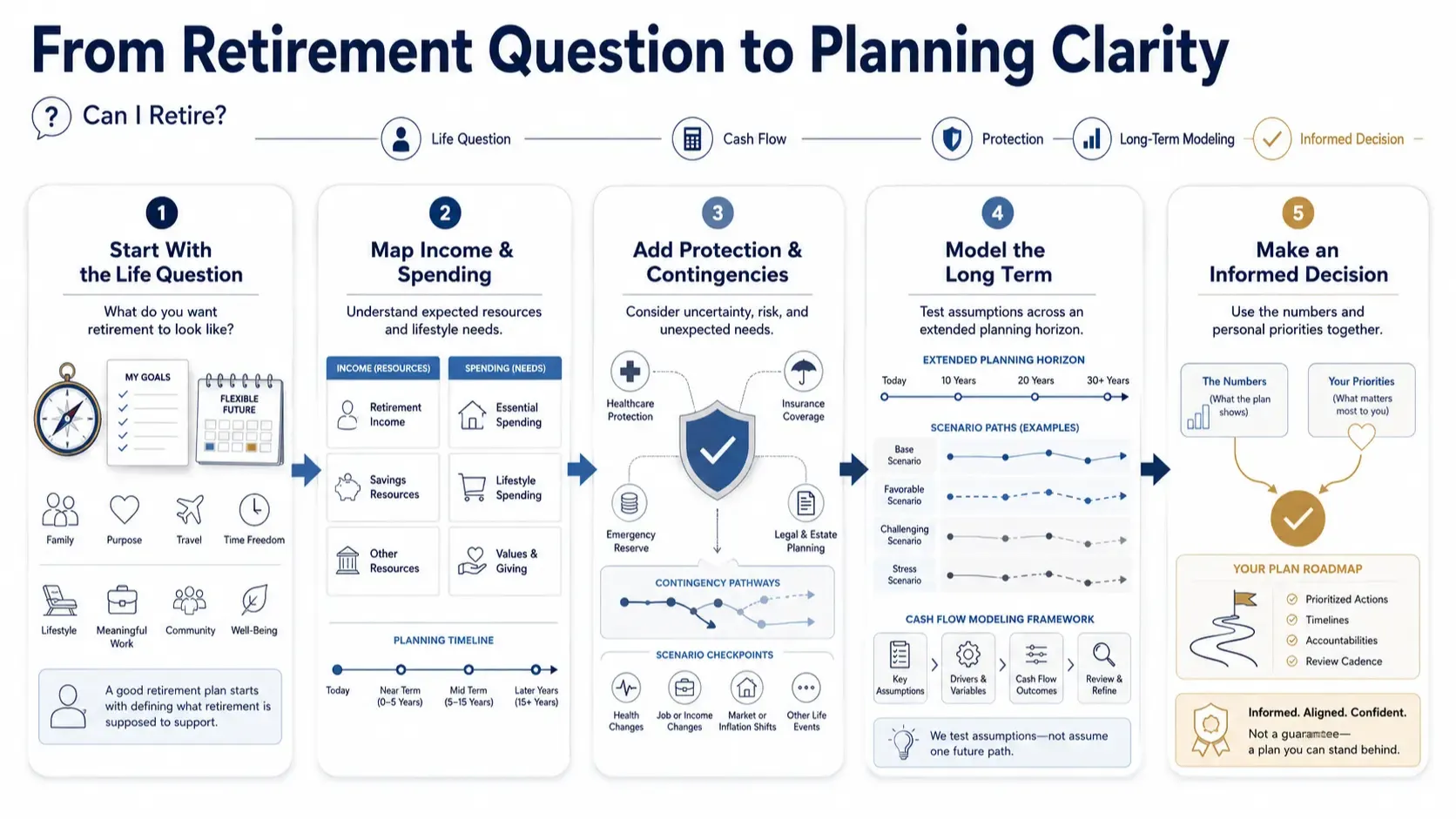
Emma shared the story of a client who came to her with one very direct question: “Can I retire?” Based on her experience, she believed the numbers were likely to support retirement. But experience alone was not what gave the client confidence.
The model did.
They extended the assumptions beyond age 100 and stress-tested the plan. Seeing income, spending, resources, and future needs mapped over time gave the client a clearer picture of what retirement could look like. According to Emma, he retired a few months later with greater peace of mind.
That distinction matters. A professional saying, “I think you are okay,” is very different from helping somebody understand why the plan appears sustainable under the assumptions being used.
Cash-flow modeling can help organize questions such as:
- What income may be available after work stops?
- How might spending change over time?
- What happens if retirement begins earlier or later?
- What financial resources are available for unexpected events?
- How might significant family or lifestyle goals affect the plan?
- Where could additional protection or flexibility be useful?
A model is not a promise about the future. Assumptions can change and real life rarely follows a perfect projection. Its value is in making the tradeoffs easier to see and discuss.
That is why financial readiness and emotional readiness should be considered together. The FiduciWho Short about being financially and emotionally ready to retire is especially relevant here. Retirement is not simply reaching a number; it is being prepared to live the next chapter with confidence.
For another perspective on building a plan around life rather than a retirement date alone, Fritz Gilbert’s conversation about living with purpose in retirement adds an important dimension.
Fiduciary Financial Planning Requires Transparency, Fit, and Collaboration
Trust is easier to talk about than to operationalize.
Emma’s approach emphasizes discovery first, transparent conversations about fees, and a professional culture that rewards doing the work well rather than treating new business as the only measure of success.
That matters because clients deserve to understand both the planning recommendation and the relationship surrounding it. What services are being provided? How is the professional compensated? What decisions are being coordinated? Who else needs to be involved?
Financial planning also does not happen in a vacuum. Tax decisions can affect investment and retirement decisions. Legal documents can affect estate and family outcomes. Insurance may interact with protection, business, or legacy planning.
Emma described coordinating with accountants and solicitors so the different pieces of a client’s financial life can pull in the same direction.
I believe collaboration is a sign of strong planning, not weakness. No one professional needs to pretend to be the expert in every discipline. The important thing is that the client’s advisors communicate when the situation requires it.
This is one reason Jesse Cramer’s lesson that smart planning beats trying to outsmart every financial variable fits so well here. The goal is not complexity for its own sake. The goal is coordinating decisions around what the client is actually trying to accomplish.
Financial Literacy and Family Money Conversations Matter
Emma and I also share a strong belief that financial literacy needs to begin earlier than it usually does.
She described having age-appropriate money conversations with her six-year-old using a simple idea: spend the copper coins, save the silver ones, and protect the paper.
The terminology is simple because it should be. A six-year-old does not need an advanced investment lecture. The goal is to begin forming habits and giving money a vocabulary.
The same principle applies as children grow older. Families do not need to disclose every financial detail immediately, but they can explain where money comes from, why saving matters, how choices involve tradeoffs, and what the family values.
Too many families follow an unspoken no-talk rule around money. Then everyone is surprised when the next generation is not prepared to manage what eventually comes their way.
I often say that wealth without wisdom rarely lasts.
If you want assets to have a lasting impact, pass down more than the assets. Explain the origin story. Talk about the work that created the opportunity. Discuss the responsibilities attached to wealth and what you hope it allows future generations to accomplish.
The FiduciWho Short encouraging parents to talk to their kids about money reinforces how powerful those early conversations can be. Financial literacy becomes much easier when money is not treated as a forbidden subject.
Integrity and Consistency Beat Financial Shortcuts
One of Emma’s messages to younger advisors was straightforward: stay honest, be stubborn, and keep doing the difficult things consistently.
I have seen the same lesson play out throughout my career.
Financial planning rarely turns on one brilliant move. Neither does building a trusted advisory practice. Progress tends to come from doing ordinary things well, again and again.
Ask the next question. Return the call. Explain the difficult concept one more time. Admit when you do not know something. Bring in another professional when the situation requires expertise outside your lane. Update the plan when life changes.
In sports terms, you do not win a season on one swing. You stack first downs.
Consistency can sound boring compared with the promise of a clever financial shortcut. But a plan needs to work when the headlines are uncomfortable, when family circumstances change, and when the client is no longer as enthusiastic about the strategy as they were on the day it was created.
Trust grows when people see the same values reflected in the process over time.
A Simple Framework for Better Money Conversations
You do not need to overhaul your entire financial life this week. Start with one conversation you have been avoiding.
Maybe it is with yourself. Maybe it is with your spouse. Maybe it is with an adult child or aging parent.
A useful conversation can begin with a few questions:
- What is going on in our world right now? Start with reality rather than a financial product.
- What are we worried about? Naming the concern often makes the planning problem clearer.
- What do we want the money to make possible? Security, freedom, retirement, family, purpose, and legacy are different objectives.
- What do the numbers currently tell us? Bring income, spending, assets, liabilities, protection, and other relevant information into the conversation.
- What do we still not understand? Identify questions that may require a financial, tax, legal, insurance, or other qualified professional.
- What is the next decision? Turn a large financial concern into one manageable step.
The objective is not to eliminate uncertainty. It is to replace avoidance with clarity.
When appropriate, qualified financial, tax, legal, and insurance professionals can help evaluate how those conversations translate into specific decisions based on your circumstances.
Final Thoughts
Fiduciary financial planning works best when technical excellence and genuine care reinforce one another.
Emma Hall’s message is a reminder that the most important financial question is not always hidden in a spreadsheet. Sometimes it appears only after somebody feels comfortable enough to tell you what is really happening in their life.
Then the technical work begins. Model the cash flow. Test assumptions. Coordinate with the appropriate professionals. Explain the fees. Make the tradeoffs visible. Give people enough clarity to participate confidently in their own decisions.
At Raskin Global, our framework is to Protect, Grow, Enjoy, and Transfer wealth. But each part of that framework begins with understanding the person behind the plan. Protection should protect something that matters. Growth should support a purpose. Enjoyment should be intentional. Transfer should carry values as well as assets.
Your dreams matter, and your future is our priority. If there is a financial conversation you have been avoiding, consider making that the next step. And when personal circumstances require specific financial, tax, legal, or insurance decisions, work with qualified professionals who can evaluate the details with you.
Frequently Asked Questions
What is fiduciary financial planning?
Fiduciary financial planning puts the client’s interests, goals, circumstances, and understanding at the center of the planning process while using disciplined financial analysis to evaluate appropriate strategies.
How does cash-flow modeling help with retirement planning?
Cash-flow modeling can show how income, spending, assets, protection, and future assumptions may interact over time, helping people see the tradeoffs involved in decisions such as when to retire.
Why should a financial advisor ask personal questions before discussing investments?
Financial recommendations depend on the life they are intended to support. Understanding concerns about family, debt, business risk, retirement, lifestyle, and other priorities can provide important context before specific strategies are evaluated.
Why is financial literacy important for families?
Financial literacy helps family members understand saving, spending, tradeoffs, responsibility, and the purpose behind wealth. Passing financial knowledge and values can be as important as passing assets.
Why should financial advisors collaborate with accountants and attorneys?
Financial, tax, legal, estate, and insurance decisions can affect one another. Collaboration among qualified professionals can help identify conflicts and improve coordination around the client’s broader goals.
What is a good first step if I feel overwhelmed by financial planning?
Start by identifying the financial question or conversation you have been avoiding, clarify what you want the money to accomplish, gather the relevant facts, and determine whether qualified professional guidance is needed for the next decision.