


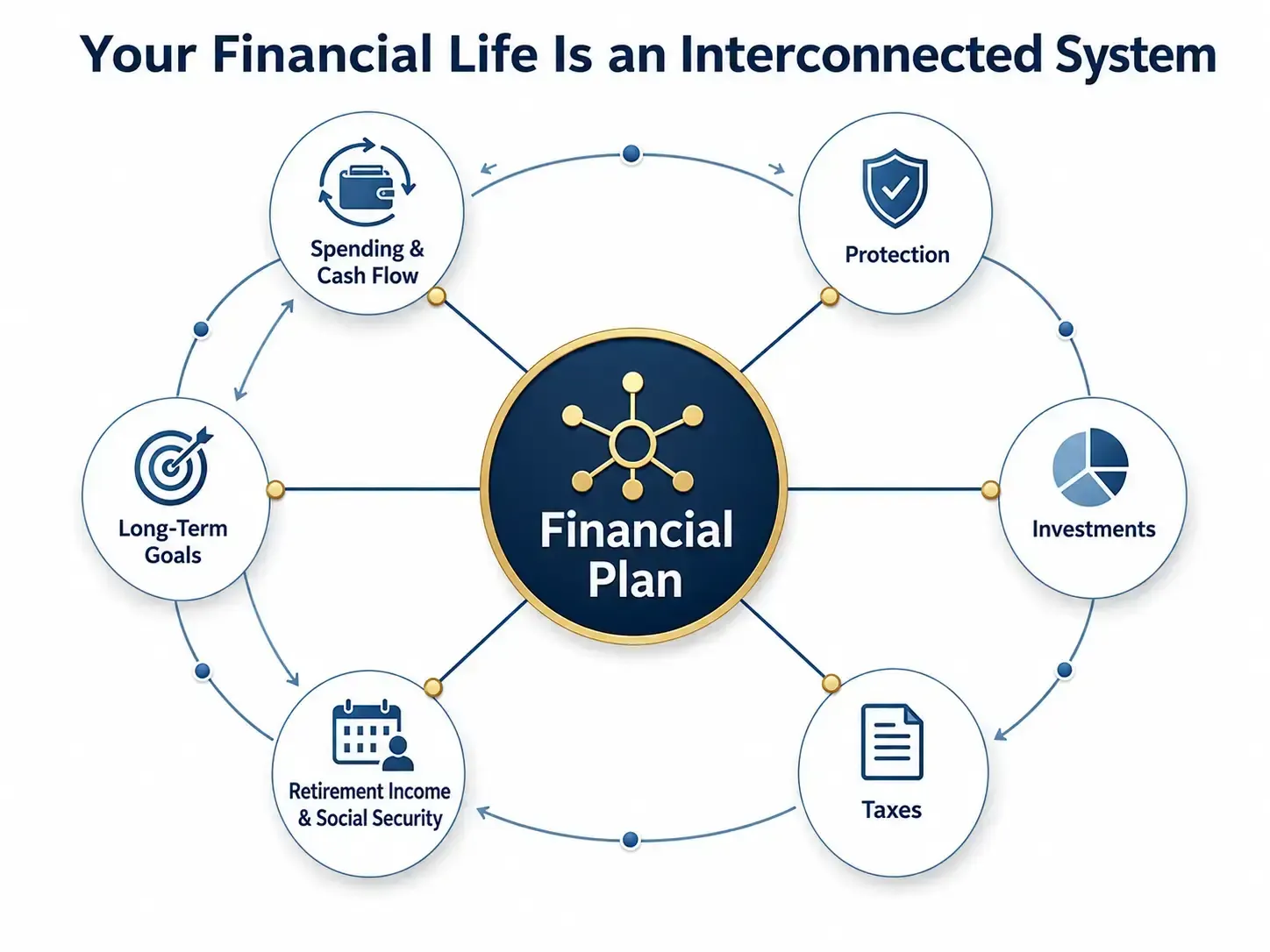
Financial planning can get complicated in a hurry. Social Security can affect taxes. Taxes can affect retirement cash flow. Spending affects savings. Investment risk affects how comfortably you can respond when markets move. Insurance decisions can affect how well the rest of the plan holds together when life does not go according to plan.
That complexity was at the center of my FiduciWho conversation with Jesse Cramer, an engineer-turned-financial advisor and host of The Best Interest. Jesse brought an aerospace engineer’s way of thinking to personal finance, and one of his best illustrations was comparing retirement planning to a spider web: tug on one thread, and the movement travels throughout the system.
That idea reflects something I have seen throughout decades in financial planning. The technical details matter, but most people do not need a lecture on every moving part. They need financial planning clarity. They need to know where they stand, what matters most, what risks deserve attention, and why the strategy makes sense.
Good planning is not about making money more complicated. It is about taking complexity and turning it into decisions people can understand.
Quick Answers
What does financial planning clarity mean? Financial planning clarity means understanding how your spending, savings, protection, investments, retirement decisions, and goals fit together without being overwhelmed by unnecessary complexity.
Why is spending such an important part of financial planning? Spending determines how much cash flow remains available for saving, investing, protection, and future goals. When spending is underestimated, the rest of the plan may be built on assumptions that do not reflect real life.
Why should protection come before growth? Wealth-building can be weakened when important risks are ignored. Appropriate insurance, legal planning, emergency resources, and other forms of protection can help create a more stable foundation before focusing heavily on growth.
Why is chasing recent investment performance risky? Recent winners do not automatically remain future winners. A thoughtful investment strategy should reflect goals, time horizon, diversification, and risk tolerance rather than last year’s performance.
What is the value of a financial advisor beyond technical knowledge? Technical expertise matters, but so do listening, communication, empathy, and the ability to turn complex financial decisions into a plan a client can understand.
Financial Planning Is a Connected System, Not a Collection of Separate Decisions
Jesse’s engineering background gives him a useful way of looking at financial planning. In aerospace work, systems are interconnected. A change in one component can create consequences somewhere else. Retirement planning works much the same way.
Consider Social Security. A decision about when to claim benefits can influence retirement income, taxes, portfolio withdrawals, and cash flow. A change in taxable income may affect other expenses. Spending decisions affect how much must be withdrawn from savings. Investment risk can influence how comfortable someone feels maintaining those withdrawals when markets are volatile.
The problem is that people are often introduced to these issues one at a time. They hear about Social Security from one source, investing from another, taxes somewhere else, and insurance from someone different. Without a coordinated framework, they are left trying to assemble the pieces themselves.
That is why I believe clarity comes before complexity. You need to understand the big picture before disappearing into the technical weeds.
This is also why Jesse Cramer’s earlier FiduciWho discussion about why smart planning can matter more than trying to be the smartest investor connects so naturally with this conversation. A portfolio is only one part of a financial life.
Simplicity Builds Trust Better Than Financial Jargon
One of the biggest mistakes professionals can make is confusing complexity with value.
An advisor may understand tax brackets, sequence-of-returns risk, Roth conversions, portfolio construction, insurance structures, and retirement-income calculations. That knowledge matters. But technical expertise does not help much if the client walks away more confused than when the conversation started.
I often describe it this way: most people do not want to know how every gear inside the watch works. They want to know the time and trust that the mechanism is working properly.
Some people want every detail. Engineers, physicians, analytical business owners, and spreadsheet enthusiasts may enjoy going deep. Others want the executive summary. Good advice means understanding which person is sitting across from you and communicating accordingly.
Clarity should increase confidence, not dependence. A client should understand the important decisions even if they do not personally want to perform every calculation.
The FiduciWho Short on why trust is a powerful asset fits here because the advisor-client relationship depends on more than technical competence. People also need to trust the process and the person guiding it.
Your Spending May Be the Biggest Financial Planning Blind Spot
Jesse and I agree on one of the least glamorous truths in personal finance: spending is often where the plan breaks down.
People frequently have a number in their heads for what they spend each month. But when income, savings, and account balances are compared, the math does not always support that estimate.
That does not mean people are irresponsible. Modern spending is simply easy to overlook. Online purchases, subscriptions, meals, travel, gifts, home projects, entertainment, and one-time expenses can disappear into the background because no single purchase feels significant.
One approach I have used is to make spending assumptions testable. If a household believes it can live on a certain monthly amount, the planning process can isolate that amount for spending while allowing the remaining cash flow to accumulate separately. Over time, the real numbers tell the story.
The objective is not punishment. It is awareness.
When spending becomes visible, families can make more deliberate choices about what they enjoy today and what they want to save for tomorrow. Financial planning is not about telling people they cannot enjoy their money. It is about making sure spending supports the life they actually want rather than quietly working against it.
The FiduciWho Short Let People See the Numbers reinforces this idea from another angle: better decisions often begin when the numbers are visible enough to understand.
Protect First, Then Focus on Growing Wealth
Another lesson I have repeated throughout my career is simple: you cannot build a strong financial future on a shaky foundation.
People naturally get excited about growth. Investments are interesting. Markets make headlines. Returns are easy to compare. Protection usually feels less exciting.
But a family can spend decades building wealth and still be financially vulnerable if major risks have not been considered. Depending on individual circumstances, protection planning may involve life insurance, disability coverage, liability protection, emergency reserves, legal documents, and other risk-management tools.
The appropriate strategies vary considerably from one person to another, which is why these decisions should be evaluated with qualified financial, insurance, legal, and tax professionals where appropriate.
The principle, however, is straightforward: identify what could seriously disrupt the plan before concentrating only on how quickly the assets might grow.
This is the foundation of FiduciWho Part 1: Protect Your Wealth, and the same idea comes through clearly in the Short explaining why the first step is protection, not growth.
Hindsight Bias Can Make Investing Look Easier Than It Really Is
Another trap Jesse and I discussed is hindsight bias. Once an investment has performed well, its success can look obvious in retrospect.
That is when people start saying things like, “Why not just put everything into the thing that has been doing best?”
The problem is that yesterday’s winner does not arrive with a guarantee attached to tomorrow.
I compare it to standing at a roulette table after red has appeared repeatedly and assuming red must somehow be the smarter bet. Recent history may feel persuasive, but it does not change the uncertainty of what comes next.
Financial planning clarity means separating evidence from hindsight. Asset allocation should be connected to goals, time horizon, liquidity needs, diversification, and the amount of volatility a person can realistically tolerate. It should not be based solely on the last investment that dominated the headlines.
That is also the lesson behind the FiduciWho Short explaining why you cannot outsmart the market simply by chasing what has already happened.
For another perspective on disciplined investing, Victor Haghani’s discussion of smarter investment decisions explores why process matters more than prediction.
The Human Connection Is Still the Most Important Part of Financial Advice
After decades in this profession, I can tell you that technical knowledge matters enormously. But technical knowledge alone is not what people remember when life gets difficult.
They remember whether you listened.
They remember whether you returned the call when the market was falling, whether you explained the decision in language they could understand, and whether you were present when retirement, illness, death, college expenses, business challenges, or other major transitions changed the plan.
I have worked with widows dealing with life insurance proceeds, parents thinking about education costs, and business owners trying to protect what they spent years building. The technical answer is important. The human context is what makes the answer meaningful.
Jesse described an ideal client relationship as one in which the person values the help, needs the help, is enjoyable to work with, and can pay for the help. That is a useful reminder that financial planning is a relationship, not simply a transaction.
For a related perspective, Dennis Harhalakis’s conversation about the emotional side of money shows why financial decisions cannot be separated completely from human behavior, fear, confidence, and relationships.
What Financial Planning Clarity Looks Like in Practice
Financial planning clarity does not mean making every issue simple. Some decisions really are complicated. Taxes can be complicated. Retirement-income planning can be complicated. Insurance contracts can be complicated. Investment decisions can involve real tradeoffs.
The goal is to organize those details around a few understandable questions:
- What are we trying to accomplish? Start with the life, family, business, retirement, and legacy goals that actually matter.
- What could derail the plan? Identify spending issues, concentration risk, inadequate protection, cash-flow pressure, or other vulnerabilities.
- What decisions affect one another? Evaluate retirement income, taxes, investments, protection, and spending as connected parts of one system.
- What information actually matters? Use enough detail to make a thoughtful decision without confusing activity with progress.
- Who needs to be involved? Bring in qualified financial, tax, legal, insurance, or other professionals when the decision requires specialized expertise.
Good planning is not about guessing the future. It is about preparing for it. That preparation becomes much easier when the strategy is understandable enough to follow when circumstances change.
Final Thoughts
My conversation with Jesse Cramer reinforced something I have believed for a long time: the best financial planning often makes complicated things feel simpler.
You need to understand your spending. You need to protect the foundation before becoming obsessed with growth. You need an investment process that is based on your goals rather than yesterday’s headlines. And you need advisors who understand that financial planning is ultimately about people, not spreadsheets.
Your dreams matter, and your future is our priority. Protecting, growing, enjoying, and eventually transferring wealth requires technical knowledge, but it also requires clarity about what the money is supposed to accomplish.
If your financial life feels like a collection of disconnected accounts, policies, investments, and decisions, consider reviewing how those pieces work together. A qualified financial professional can help you evaluate the relationships among them and determine which questions deserve attention based on your circumstances.
Frequently Asked Questions
What is financial planning clarity?
Financial planning clarity means understanding your goals, cash flow, risks, investments, protection, and retirement decisions well enough to see how they work together and make informed choices.
Why is spending important in a financial plan?
Spending affects how much money remains available for saving, investing, protection, retirement, and other goals. Accurate spending information gives the rest of the financial plan a more realistic foundation.
Why should financial protection come before investment growth?
Protection planning can help address risks that may disrupt years of wealth-building. Depending on individual circumstances, that may involve insurance, reserves, legal planning, or other risk-management strategies evaluated with qualified professionals.
What is hindsight bias in investing?
Hindsight bias is the tendency to look at past results and believe the winning investment was more predictable than it actually was. It can encourage investors to chase recent performance instead of following a diversified, goal-based strategy.
Why does simplicity matter in financial advice?
Simplicity helps people understand the decisions that affect their financial lives. An advisor can manage technical complexity while still explaining the strategy in language the client can understand and use.
Why is human connection important in financial planning?
Financial decisions often involve uncertainty, family, retirement, loss, business, and major life transitions. Technical knowledge matters, but listening, empathy, communication, and trust help make that knowledge useful in real life.