


For years, the traditional formula has sounded simple: work hard, save diligently, reach financial independence, and then begin enjoying your time. There is just one problem. Life does not always cooperate with a plan that asks you to postpone everything meaningful until some distant retirement date.
Brian Herriot offers a useful way to turn that formula around. Instead of waiting for complete financial freedom before pursuing time freedom, he encourages people to begin creating greater control over their schedules now while their long-term financial progress continues in the background.
That does not mean ignoring the numbers, abandoning responsibility, or making reckless financial choices. It means getting clear about what money is supposed to do for your life. The numbers matter, but the life behind the numbers matters more.
Time freedom is especially relevant for entrepreneurs, professionals, and business owners who pursued success partly to gain flexibility but discovered that their responsibilities now control nearly every hour. It also matters for families and future retirees who want to enjoy meaningful experiences while they have the health, relationships, and energy to do so.
Key Takeaways
- Time freedom means gaining meaningful control over your schedule today, rather than waiting until retirement to begin living differently.
- Business ownership does not automatically create freedom. Owners may need to delegate, reorganize responsibilities, and redesign how work gets done.
- Small scheduling changes can create meaningful progress. Extended weekends and structured time away can gradually build a more flexible life.
- Financial planning must support the desired timeline. Long-term growth still matters, but so do liquidity and access to money before traditional retirement age.
- Stepping away can create perspective. Time outside daily operations may help entrepreneurs think more creatively and strategically.
Why Time Freedom Changes the Retirement Question
Traditional retirement planning often begins with a date and a dollar amount: When do you want to retire, and how much will you need? Those are important questions, but they are not the only ones worth asking.
A more complete conversation also considers how you want to live between now and then. What would you do with more control over your week? Which experiences are easy to postpone but difficult to replace? How much of your desired retirement lifestyle could be introduced gradually rather than saved for one major transition?
Time freedom does not necessarily mean that you stop working. It may mean choosing when you work, how much you work, what responsibilities you keep, and which parts of your life receive your best energy. Retirement, in that sense, is not merely the finish line. It can be the continuation of a life already designed around purpose.
This is why the idea in “Retirement Isn't the Finish Line, It's the Starting Line” matters: retirement planning should prepare you for a meaningful next chapter, not simply the absence of a job.
When Business Ownership Becomes a Job You Cannot Leave
Many entrepreneurs start businesses because they want independence, flexibility, and the ability to shape their own future. Yet a business can become more demanding than the job it replaced.
The owner approves every decision, solves every problem, maintains every important relationship, and steps in whenever something goes wrong. Revenue may grow while personal freedom shrinks. The business owns the calendar because too much depends on one person.
Reclaiming time requires an honest look at responsibilities. Which tasks genuinely require the owner's judgment? Which can be delegated? Which processes exist only in the owner's head? Where could the work structure change without compromising service or accountability?
This is not a call to disappear from your company. It is a call to build an organization that can function without your constant presence. The lesson connects closely with the challenge of escaping hero syndrome and creating genuine business freedom. If the owner must rescue every situation, neither the owner nor the team has room to develop.
Business freedom is built by strengthening the people and systems around you. That work may happen gradually, but each responsibility transferred thoughtfully can return a small piece of your time.
Build Time Freedom Through Seasonal Schedules
One of the most practical ideas in Brian's approach is that freedom does not have to arrive all at once. You can test it in smaller, structured ways.
A seasonal schedule recognizes that work and life do not always need to operate at the same intensity. A business owner might create regular extended weekends, designate periods for concentrated work, or establish planned time away from daily operations. The exact structure will depend on the business, family responsibilities, and financial circumstances.
The principle is more important than any single schedule: begin intentionally reclaiming time instead of assuming it will appear later.
Start with a manageable experiment
Rather than attempting an immediate and dramatic lifestyle change, consider a limited test. Identify a modest block of time you would like to protect, decide what must change to make it possible, and observe where the plan succeeds or breaks down.
That test may expose unclear roles, unnecessary meetings, weak systems, or a habit of remaining involved in decisions that someone else could handle. Those discoveries are useful. They show you what must improve before greater freedom becomes practical.
Let consistency do the heavy lifting
A single day away may not feel transformational. Regularly protected time, however, can begin changing the rhythm of a year. Incremental improvements may eventually produce significant periods for family, travel, rest, learning, or creative work.
The goal is not to avoid responsibility. It is to stop treating your own life as the one commitment that can always be rescheduled.
Financial Planning for Time Freedom Requires a Different Balance
If you want to use more of your time earlier in life, your financial plan must account for that choice. Money committed exclusively to distant goals may not be available when you want to reduce work, take an extended break, or redesign your business schedule.
That does not make long-term investing unimportant. It means growth and accessibility must be considered together. A time-freedom plan may need to examine cash flow, liquidity, protection, business obligations, long-term savings, and the financial demands of a changing work schedule.
The right balance is personal. It depends on income, expenses, taxes, business structure, family commitments, risk tolerance, and other circumstances. Before moving money or changing a retirement strategy, consult qualified financial, tax, and legal professionals who can evaluate the full picture.
This is where smart planning is more valuable than chasing a supposedly perfect investment. The discussion in “Smart Planning Beats Smart Investing” reinforces the same idea: financial decisions should serve a coherent life plan rather than exist as isolated products or performance targets.
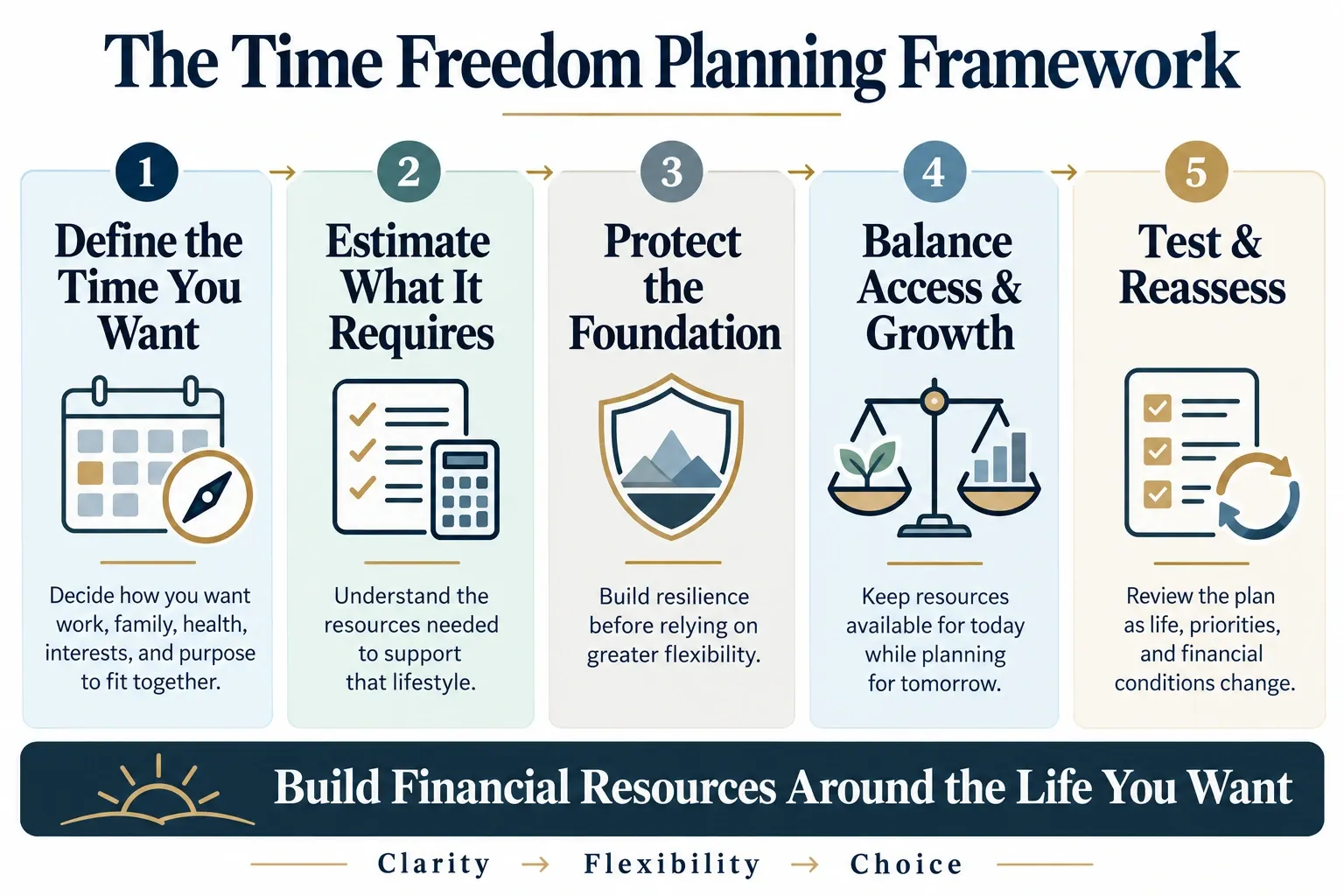
A practical planning sequence
- Define the time you want. Describe the schedule or season of freedom you are trying to create.
- Estimate what it requires. Consider the income, liquidity, staffing, and personal adjustments involved.
- Protect the foundation. Review emergency resources, risk exposure, essential obligations, and business continuity.
- Balance current access with future growth. Avoid treating every dollar as though it has the same purpose or timeline.
- Test and reassess. Start with a manageable change, then evaluate its financial and personal effects.
The first benefit of money is not the ability to accumulate more of it. It is the range of thoughtful choices money may help support. The short video “The ONE Real Benefit of Money” offers a concise reminder that money is most useful when it creates options for the life that matters to you.
Stepping Away Can Make You a Better Leader
Entrepreneurs sometimes fear that time away will slow the business down. Yet remaining immersed in daily tasks can create a different problem: there is no room to think beyond the next issue.
Planned time away can provide perspective. When you are not reacting to email, approvals, staffing questions, or customer demands, you may have more capacity to consider larger questions. Where is the company going? Which work is no longer valuable? What could the team handle with better direction? What opportunities are difficult to see from inside the daily routine?
Time away also functions as a practical test. If the business cannot operate for a short period without the owner, that reveals a structural vulnerability. The answer is not necessarily to cancel the break. The better response may be to strengthen delegation, documentation, decision-making authority, and leadership capacity.
A fresh perspective can expose assumptions that daily familiarity hides. The FiduciWho short “You Need Someone with a Fresh Perspective” relates to this challenge: better decisions often begin when we create enough distance to see the situation differently.
Define Success Before Optimizing the Numbers
Financial freedom can become an endlessly moving target. There is always another milestone, another revenue goal, or another amount that might make a person feel more secure. Without a clear definition of enough, success may keep getting postponed.
Time freedom begins with a different question: What do you want your days to make possible?
The answer might involve family, health, service, travel, creative work, community, or simply the ability to be present without constantly checking the next obligation. No advisor, spreadsheet, or financial product can define that for you.
Once the desired life is clearer, planning becomes more useful. You can examine whether your business, savings, spending, and investments support that vision. You can also recognize tradeoffs honestly. More time today may require slower financial growth, different business systems, or fewer discretionary expenses. In other cases, better organization may create freedom without requiring a major financial sacrifice.
Brian's central point is not that financial freedom should be abandoned. It is that time freedom does not always have to wait for it. His broader perspective is explored in the FiduciWho conversation about why time freedom matters.
Turn the Idea Into a Practical Conversation
If time freedom sounds appealing, begin with clarity rather than complexity. Write down one meaningful change you would make if you controlled more of your schedule. Then identify the business, financial, and personal conditions needed to support it.
For a business owner, that may lead to conversations about delegation and continuity. For a professional, it may involve career flexibility, savings, or a phased work schedule. For someone approaching retirement, it may reveal that emotional readiness and purpose deserve as much attention as account balances.
A fiduciary-minded financial planning conversation can help connect these goals to cash flow, risk management, investment timelines, retirement resources, and legacy priorities. The purpose is not to force every person into the same model. It is to make sure the plan reflects the life you are actually trying to build.
If you are considering a major change to your work schedule or financial strategy, discuss it with qualified professionals before acting. A thoughtful review can help you understand the tradeoffs and avoid solving a time problem by creating an unnecessary financial one.
Final Thoughts
Time is not simply another asset on a financial statement. It is where your relationships, health, purpose, and memories live.
That is why time freedom deserves a place in financial planning. Protecting wealth can create stability. Growing it can expand future possibilities. Enjoying it can help you live meaningfully now. Transferring it can support the people and causes that matter after you. But all four should serve a life you recognize as your own.
You do not necessarily need to choose between enjoying today and preparing for tomorrow. With clear priorities, appropriate safeguards, and professional guidance, you may be able to make progress toward both. Start by defining the time you want, then ask whether your business and financial plan are helping you create it.
Frequently Asked Questions
What is time freedom?
Time freedom is the ability to exercise meaningful control over when you work, how you structure your schedule, and where you direct your time. It does not necessarily mean stopping work; it means designing work around a purposeful life rather than postponing life until retirement.
How is time freedom different from financial freedom?
Financial freedom generally refers to having enough financial resources to support your lifestyle without depending entirely on active work. Time freedom focuses on gaining greater control over your schedule, which may begin well before complete financial independence.
Can business owners create more time freedom without selling their companies?
Potentially. Business owners may be able to create more flexibility by delegating responsibilities, documenting processes, developing leaders, and reducing the company's dependence on the owner. The appropriate approach depends on the business and should be evaluated carefully.
What is a seasonal schedule?
A seasonal schedule intentionally varies work intensity during different periods. It might include regular extended weekends, focused work seasons, or planned time away, depending on personal goals and business responsibilities.
How should financial planning account for time freedom?
Planning for time freedom should consider cash flow, liquidity, long-term growth, risk protection, business obligations, and access to funds before traditional retirement age. Individual decisions should be reviewed with qualified financial, tax, and legal professionals.
Why does emotional readiness matter when reducing work?
Work often provides identity, structure, relationships, and purpose. A person may be financially capable of working less but still feel uncertain about how to use the additional time. Planning for purpose and routine can be as important as preparing the finances.