


For decades, I have taught families and business owners to think about wealth through a straightforward framework: protect it, grow it, enjoy it, and transfer it. But every part of that framework rests on something a financial statement cannot fully measure—your health.
My conversation with Stevyn Gunnip reinforced a lesson that is easy to understand and just as easy to neglect: a strong financial plan has less power when your health cannot support the life the plan was built to provide. Money may help create choices, but energy, mobility, and well-being help you use those choices.
That is why health and financial planning should not live in separate conversations. Both require an honest baseline, consistent habits, sensible protection, and the willingness to make small decisions today for a better tomorrow. The numbers matter, but the life behind the numbers matters more.
Quick Answers
Why do health and financial planning belong together? Financial resources can create freedom and opportunity, while health helps you participate in the life those resources make possible. Planning works best when both are moving in the same direction.
What is health debt? Health debt is the accumulated effect of repeatedly neglecting sleep, stress management, nutrition, movement, and recovery. Like financial debt, it may build quietly before its consequences become obvious.
Where should someone begin? Begin with clarity. Understand your current health patterns and financial position before setting ambitious goals or adopting a complicated strategy.
What are the Three W’s? Water, walking, and weights provide a simple framework for building healthier habits without trying to change everything at once. Personal medical needs should always be discussed with an appropriate healthcare professional.
Health and Financial Planning Start With the Same Question
Good planning begins by asking, “What do I want my life to look like?” That question comes before investment products, account balances, exercise programs, or meal plans.
Do you want to travel in retirement? Spend active time with your grandchildren? Continue working because you enjoy it rather than because you have to? Volunteer, mentor, build another business, or simply have the energy to enjoy an ordinary Tuesday?
Those goals require financial readiness, but they also require physical and emotional readiness. Retirement is not merely the day you stop working. It is the beginning of a different chapter, and you want to arrive with the ability to live it. The short video Make Sure You’re Financially and Emotionally Ready to Retire reinforces why a retirement date and an account balance do not tell the whole story.
Stevyn saw this problem early while watching her father work as a financial advisor. Some people reached retirement with adequate financial resources but lacked the health to enjoy what they had built. Her path eventually led into exercise physiology and work focused on the intersection of wealth and wellness.
Her experience offers a valuable reminder: the purpose of planning is not simply to accumulate. It is to support a life worth living. That same theme runs through our earlier discussion of moving from wealth to “wellthy” living.
A Personal Wake-Up Call About Health
Stevyn’s lesson was not merely professional. After moving her family to Australia to launch a fitness program, long hours, stress, and a determination to keep pushing caught up with her. She became septic, required emergency surgery, and nearly lost her life.
There is a humbling truth in that experience. Knowing what to do does not guarantee that we will do it. Financial professionals can ignore their own financial housekeeping. Business owners can postpone succession planning. Health professionals can overlook sleep, recovery, and stress while caring for everyone else.
During a long recovery, Stevyn came to see that genuine health is not necessarily built through extreme effort. It is usually built through small choices repeated over time. That is remarkably similar to building wealth. One dramatic action rarely replaces the value of steady, sustainable habits.
This is not an argument for perfection. None of us will make the best decision every day. It is an argument for awareness and direction. If your daily choices generally support the life you want, time can become an ally rather than an obstacle.
Understanding the Cost of Health Debt
One of Stevyn’s most useful concepts is “health debt.” When we are younger, the body may appear to absorb late nights, skipped meals, limited movement, and chronic stress. That can create the illusion that there is no bill coming.
Over time, however, the balance may begin to show up through low energy, poor sleep, reduced mobility, mental fog, rising health markers, or the feeling that routine activities take more effort than they once did. The specific signs and their causes vary, which is why health concerns should be evaluated by qualified medical professionals.
The planning parallel is hard to miss. Financial debt can grow when interest and new spending continue without a repayment plan. Health debt may also compound when poor habits remain unexamined. In both cases, avoiding the statement does not change the balance.
Denial can feel comfortable in the short term. We may avoid opening an investment statement during a difficult market or resist looking at health information because we are afraid of what it might say. But clarity is not the enemy. Clarity gives us a place to begin.
That is why I believe the first step is protection. Before reaching for greater growth, understand what you already have and what could put it at risk. Our article on how to protect your wealth as the foundation of a financial plan applies the same principle to your financial life.
Establish a Baseline Before Setting Bigger Goals
People often respond to discomfort by reaching for a dramatic solution. They start an intense workout program, impose a highly restrictive diet, or overhaul their finances overnight. The initial enthusiasm may be real, but an approach that cannot be sustained is unlikely to produce lasting progress.
Stevyn recommends beginning with a baseline. Depending on the individual and the guidance of appropriate healthcare professionals, that may include reviewing bloodwork, sleep, stress, nutrition, and daily movement. The point is not to become obsessed with data. It is to replace assumptions with useful information.
She shared the example of an advisor who believed he slept well until data from a wearable device suggested otherwise. A device is not a diagnosis, but the experience illustrates a broader planning lesson: what we believe and what the evidence shows are not always the same.
The financial version of a baseline includes understanding cash flow, savings, debt, investments, insurance, taxes, estate documents, and the goals those resources are meant to support. You do not need complexity for complexity’s sake. You need an honest picture of where you are today.
If you are unsure where to begin, speak with qualified health and financial professionals who can help you evaluate your circumstances. Good advice should create clarity, not pressure you into a one-size-fits-all answer.
The Four Levels of Health Planning
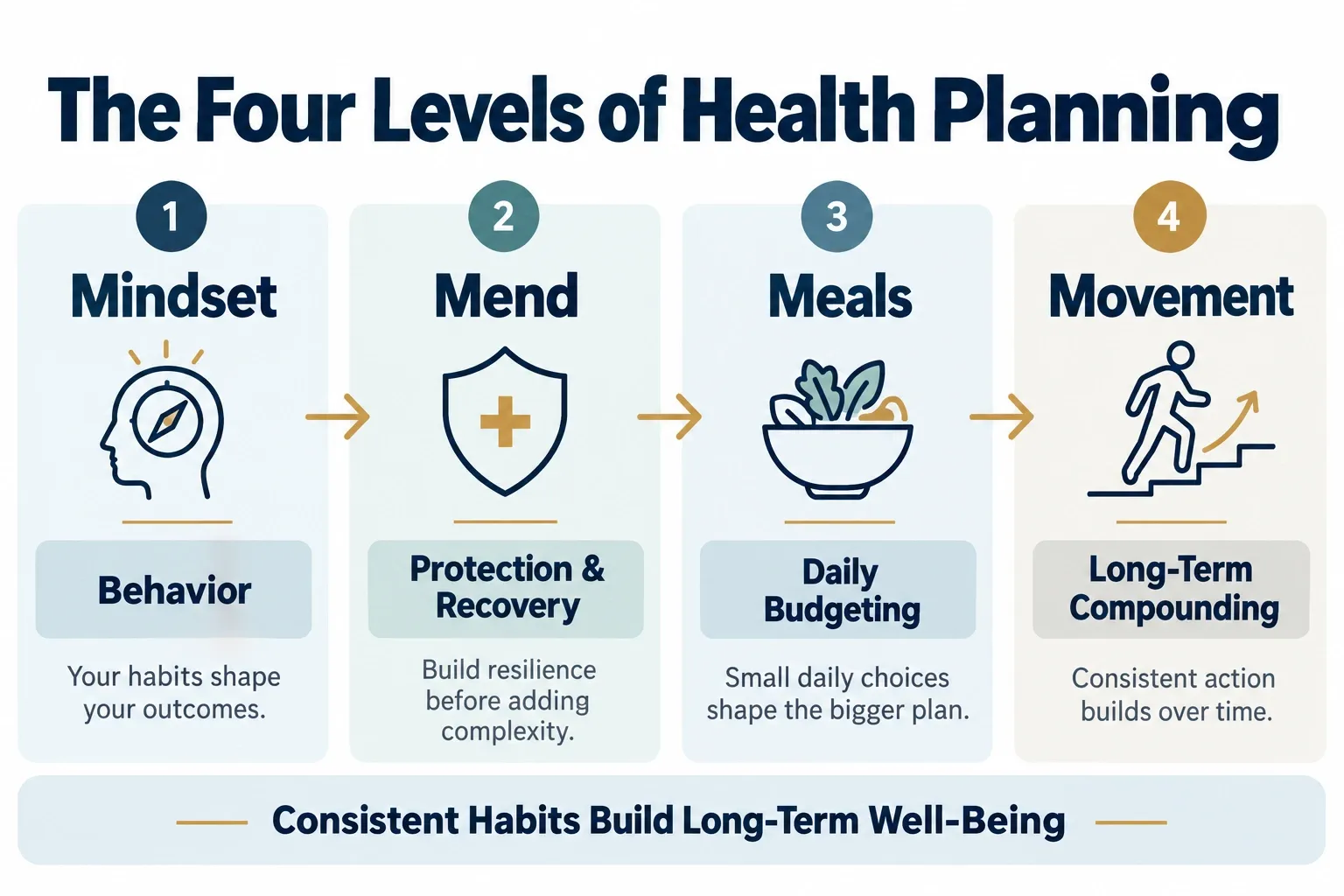
Stevyn describes a hierarchy for health that has clear financial parallels: mindset, mend, meals, and movement. Together, they provide a practical way to organize a subject that can otherwise feel overwhelming.
1. Mindset: Beliefs Shape Behavior
Our beliefs influence the choices we make. Someone who believes health requires hours in a gym may do nothing when that schedule feels impossible. Someone who believes financial planning is only for the wealthy may postpone important decisions for years.
A healthier mindset focuses on progress, responsibility, and choices that can be sustained. The goal is not to become perfect. It is to become more intentional.
2. Mend: Recovery Is Part of the Plan
Sleep and stress management are not rewards for finishing everything else. They help make everything else possible. Stevyn describes this as paying your sleep and stress bills each day.
Financial plans also need room for recovery. Emergency reserves, reasonable margins, and appropriate protection can help keep a setback from becoming a crisis. Constantly operating at maximum capacity—physically or financially—leaves little room for real life.
3. Meals: Daily Choices Form the Budget
Stevyn compares nutrition to a daily budget. The analogy is useful because both involve tradeoffs, consistency, and awareness. One meal generally does not define your health, just as one purchase generally does not define your financial future. Patterns matter more.
Nutrition needs vary, so dietary decisions should be made with appropriate professional guidance when medical conditions or personal concerns are involved.
4. Movement: Consistency Creates Compounding
Movement is the long-term investment in this framework. Walking, mobility, and appropriate strength work may help support the ability to participate in daily life. Stevyn also warns against becoming too concentrated in one form of exercise. A person may run regularly, for example, yet still struggle with strength or mobility.
That is not unlike owning only one type of investment because it happens to be familiar. Activity and investment decisions both need to reflect the individual’s goals, risks, needs, and professional guidance.
Start Small With Water, Walking, and Weights
When people feel overwhelmed, Stevyn brings the conversation back to the Three W’s: water, walking, and weights.
- Water: Pay attention to hydration rather than assuming it will take care of itself.
- Walking: Build regular movement into ordinary days.
- Weights: Consider appropriate strength training based on your health, ability, and professional guidance.
The value of this framework is its simplicity. It gives people a manageable starting point instead of a long list of rules. Anyone beginning or changing an exercise routine should consider their medical circumstances and consult an appropriate healthcare professional when needed.
The same principle applies to money. You do not have to solve every financial question this week. You can begin by reviewing cash flow, establishing an automatic savings habit, organizing important documents, or scheduling a planning conversation.
Small does not mean insignificant. Small actions become meaningful when they are repeated. The short video Build Healthy Habits Now offers a concise reminder that today’s routines can shape tomorrow’s choices.
Build a Future You Can Actually Enjoy
Many financial plans are built around a future lifestyle: travel, family time, meaningful work, charitable giving, or greater control over the calendar. Yet it is possible to spend decades funding that future without preparing physically or emotionally to live it.
A retirement plan should therefore involve more than replacing a paycheck. It should consider purpose, relationships, time, identity, and health. Fritz Gilbert’s perspective on living a retirement shaped by intention and purpose explores this broader definition of readiness.
This does not mean health outcomes are entirely within our control. They are not. Illness, injury, genetics, and unexpected events can affect even the most conscientious person. The point is to make thoughtful decisions with the information and resources available to us—not to assign blame when life takes an unwanted turn.
Money is a tool. At its best, it can support freedom, security, family, purpose, and impact. Health can help us engage with those things. Bringing the two conversations together gives us a more complete view of what genuine wealth can mean.
If this article has revealed a gap between the future you are funding and the life you are preparing to live, consider discussing that gap with qualified health and financial professionals. A good plan should help you protect what matters, grow your resources thoughtfully, enjoy what you have built, and prepare to transfer wealth and values with purpose.
Final Thoughts
Health and financial planning run on parallel tracks. Both begin with clarity. Both depend on behavior. Both can improve through small, consistent decisions, and both become harder when warning signs are ignored.
Your financial plan should do more than help you reach a number. It should support the people, experiences, responsibilities, and purposes that give the number meaning. Protect what you have, grow it wisely, enjoy it while you can, and transfer it thoughtfully—but remember to care for the first asset that allows you to participate in all four.
Take one practical step this week. Review one area of your financial life, examine one health habit honestly, and seek qualified guidance where your personal circumstances require it. Clarity should come before complexity, and steady progress is more valuable than a plan you cannot sustain.
Frequently Asked Questions
What is health and financial planning?
Health and financial planning means coordinating the resources you are building with the physical and emotional well-being needed to use them. It connects financial goals with the life, relationships, purpose, and experiences those goals are intended to support.
Why is health considered an asset in a financial plan?
Health can influence your ability to work, make decisions, travel, care for family, and enjoy retirement. It is not a financial account, but it can affect how effectively your financial resources support the life you want.
What is health debt?
Health debt is the accumulated effect of repeatedly neglecting areas such as sleep, stress, nutrition, movement, and recovery. The effects may develop gradually, and personal health concerns should be evaluated by a qualified healthcare professional.
What are the Three W’s for healthier habits?
The Three W’s are water, walking, and weights. They provide a simple starting framework for hydration, regular movement, and appropriate strength training, subject to individual ability and professional medical guidance.
How should I begin aligning my health and financial goals?
Start by gathering an honest baseline of your current habits, resources, risks, and priorities. Then identify one sustainable next step and consult qualified health and financial professionals when your personal circumstances require individualized guidance.